

Whiplash Treatment in Camarillo, CA
Move Your Neck Freely Again
- Common In:
- Adults 20 to 70
- Primary Causes:
- Collisions, Falls, Sports Impacts
- Treatment Time:
- 15-30 minutes per visit
- Results:
- Days to several months


What Is Whiplash and Why Does It Hurt Later?
Recognizing the Signs
Whiplash is a soft tissue injury of the neck caused by a rapid back-and-forth movement of the head, most often in a rear-end collision. The sudden acceleration and deceleration stretch the cervical muscles, ligaments, facet joints and discs past their normal range in a fraction of a second. Clinicians group the result under the umbrella term whiplash-associated disorder, or WAD.
Walking away from a crash feeling fine is not unusual. Adrenaline blunts pain at the scene. Over the next 24 to 72 hours inflammation builds, and neck stiffness, a headache at the base of the skull, shoulder tightness and low back pain often arrive together.
Many patients tell us the delay made them second-guess themselves, especially when the car looked barely damaged. Our article on how to take care of yourself after a car accident walks through why symptoms surface late and what to watch for during that first week.
Why Whiplash Happens
Understanding the Root Causes
01The Science
In a rear-end impact the torso is pushed forward by the seat while the head lags behind for roughly 100 to 150 milliseconds. The cervical spine briefly bends into an S shape, compressing the lower facet joints while the upper segments extend. The whole sequence finishes before your muscles can brace, which is why crashes at modest speeds still injure necks.
What follows is an inflammatory response. Strained ligaments and torn muscle fibers leak fluid into the tissue, joints become guarded, and the deep stabilizing muscles of the neck effectively switch off. The MedlinePlus (National Library of Medicine) describes whiplash as a neck injury whose pain and stiffness commonly appear a day or more after the impact rather than during it.
Left alone, that guarding pattern can outlast the tissue healing that caused it. Restoring normal joint motion early with chiropractic care for neck pain gives those deep stabilizers a reason to switch back on, which is a large part of why early evaluation matters.
02Deeper Understanding
Whiplash Grades and What They Mean
How Injury Severity Shapes Recovery
Since 1995, clinicians have sorted whiplash injuries using the Quebec Task Force scale. Grade 0 means no neck complaint and no physical findings. Grade I means you have neck pain, stiffness or tenderness but the examination is otherwise normal. Grade II adds objective findings such as reduced range of motion or point tenderness in specific muscles and joints.
Grade III adds neurological signs: weakness, altered reflexes, or numbness running into the arm and hand. Grade IV means a fracture or dislocation is present, and that injury belongs in an emergency department rather than a chiropractic office. Most collision patients we evaluate fall into Grade I or Grade II, where non-surgical care is appropriate.
The grade matters because it guides the plan. A Grade II neck usually responds to restoring joint motion and calming inflammation, while Grade III symptoms call for a nerve-focused assessment before any hands-on treatment. If radiating symptoms or an existing herniated or bulging disc are part of your picture, pinched nerve treatment is evaluated first.
What Makes Whiplash Worse?
Several factors influence how hard a collision hits your neck and how long recovery takes. A spine already managing long-standing neck pain or disc wear has less tolerance for sudden load, and those cases often respond to non-surgical spinal decompression.
- 01Head Position at ImpactBeing turned or looking down when the collision happens concentrates the force on one side of the neck and lengthens recovery.
- 02Head Restraint SetupA head restraint sitting too low lets the head travel further backward, increasing strain on the upper cervical joints.
- 03Being Caught Off GuardDrivers who never see the impact coming cannot brace, so the neck muscles absorb the load in a lengthened, unprotected position.
- 04Pre-existing Spine ChangesDisc degeneration, spinal arthritis or an old neck injury lowers tissue tolerance, so the same crash produces more symptoms.
- 05Delayed EvaluationWaiting weeks lets guarding, stiffness and compensation patterns settle in, and studies link that delay to slower recovery.
- 06High Early Pain and DistressSevere pain in the first days, along with crash-related anxiety, is among the strongest predictors of lingering symptoms.

Why Choose Camarillo Spine & Nerve Institute for Whiplash Care in Camarillo, CA
Dr. Edmond Dooman, DC has cared for collision injuries in Ventura County since the practice opened in February 1994, and he uses the Gonstead Method to pinpoint which cervical segments are actually restricted instead of adjusting the whole neck by default. Whiplash sits within our wider spine care program in Camarillo.
- Root-Cause Evaluation
- We examine the full spine and nervous system, not only the sore spot, to find what is actually driving your symptoms.
- Gonstead Precision
- Dr. Dooman identifies the specific restricted segments, so adjustments stay targeted rather than generalized.
- Technology-Assisted Care
- Spinal decompression and electrotherapy support the hands-on work and calm irritated tissue.
- Honest Expectations
- We are clear about what non-surgical care can and cannot do, and we refer out when your findings call for it.
Treatment Options Comparison
Compare the non-surgical options we use for whiplash so you know what each one is meant to do.
| Treatment | Best For | Session Time | Results Timeline | Maintenance |
|---|---|---|---|---|
| Chiropractic Adjustments | Restoring neck joint motion | 15-20 min | 1-3 weeks | Tapers as you improve |
| Laser Therapy for Pain with Emvital | Deep muscle stiffness once early inflammation settles | 10-20 min | 2-4 weeks | As symptoms flare |
| Electrotherapy | Easing muscle spasm | 15-20 min | Often same day | Paired with visits |
| Spinal Decompression Therapy | Disc-related arm symptoms | 20-30 min | 4-6 weeks | Periodic check-ins |
You May Be Experiencing Whiplash If...
Whiplash symptoms rarely arrive all at once, so if any of the signs below showed up after a collision, fall or sports impact, an examination is worth booking. Go to an emergency department instead for severe neck pain after a high-speed impact, numbness or weakness in the arms, any loss of consciousness, a worsening headache or blurred vision. Once serious injury is ruled out, electrotherapy in Camarillo, CA can help settle early spasm and pain.
Delayed Neck Stiffness
You felt fine at the scene, then woke a day or two later unable to turn your head far enough to check a blind spot.
Base-of-Skull Headaches
A dull ache starts where your neck meets your skull and wraps forward toward the temples or behind the eyes.
Shoulder Blade Tightness
Pain spreads into the shoulders and between the shoulder blades, and it is noticeably worse after a day at a desk.
Arm Tingling or Weakness
Pins and needles, numbness or a heavy feeling travels from your neck down into one arm or hand.
Dizziness and Brain Fog
You feel unsteady, foggy or oddly fatigued since the accident, and concentrating for long stretches is harder.
Jaw Ache and Poor Sleep
Your jaw aches or clicks, and finding a comfortable sleeping position has become a nightly negotiation.
Explore More Related Treatments
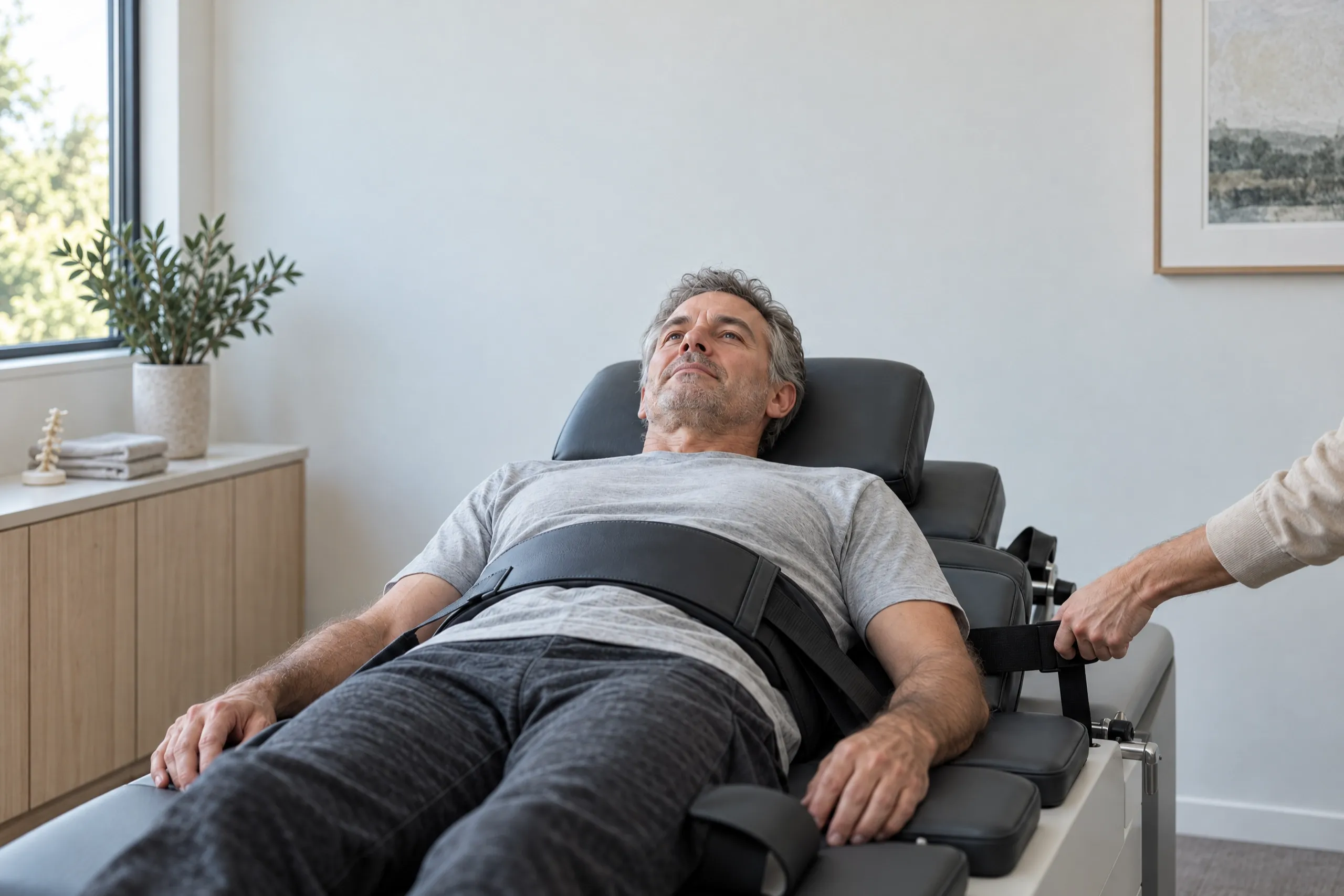
Spinal Decompression Therapy
Computer-controlled traction that eases pressure on compressed discs and the nerves around them.
- No Surgery or Drugs
- Zero Downtime
- Targets the Disc
Explore More Related Treatments
Chiropractic Adjustments
Precise Gonstead adjustments for structural and postural correction, without drugs or surgery.
- Same-Day Relief
- Segment-Specific
- No Downtime
Explore More Related Treatments
Laser Therapy for Pain with Emvital
Relief for muscle and joint pain
- Drug-Free Relief
- No Downtime
- Comfortable Warmth
Explore More Related Treatments
Electrotherapy
Gentle electrical stimulation that calms pain signals and eases muscle tension.
- No Medication
- Comfortable Session
- No Downtime



Your Questions
Frequently Asked Questions
How long after a car accident can whiplash symptoms appear?
Can a low-speed crash really cause whiplash?
How long does whiplash take to heal?
Should I wear a soft collar after a whiplash injury?
My neck X-rays were normal. Why do I still hurt?
What does whiplash care at your Camarillo office involve?
Do you accept insurance for whiplash care?
Contact Us
Schedule Your Consultation
Scientific References
- Spitzer et al., Spine (Phila Pa 1976). (1995). Scientific monograph of the Quebec Task Force on Whiplash-Associated Disorders redefined whiplash and established the Grade 0 to IV classification still used in practice. PMID: 7604354.
- Carroll et al., Spine (Phila Pa 1976). (2008). Course and prognostic factors for neck pain in whiplash-associated disorders reported that most recovery occurs within the first two to three months after injury. PMID: 18204405.
- Kamper et al., Pain. (2008). Course and prognostic factors of whiplash: a systematic review and meta-analysis found that recovery slows markedly after the first three months. PMID: 18407412.
- Rosenfeld et al., Spine (Phila Pa 1976). (2003). Active intervention in patients with whiplash-associated disorders improves long-term prognosis in a randomized controlled clinical trial compared with standard care. PMID: 14624083.
- Michaleff et al., Lancet. (2014). Comprehensive physiotherapy exercise programme or advice for chronic whiplash, the PROMISE pragmatic randomised controlled trial, found advice performed comparably to a full exercise programme. PMID: 24703832.
- Stiell et al., JAMA. (2001). The Canadian C-spine rule for radiography in alert and stable trauma patients identified clinically important cervical spine injury with high sensitivity. PMID: 11597285.