

Spinal Arthritis Treatment in Camarillo, CA
Move With Less Stiffness Again
- Common In:
- Adults 45 and older
- Primary Causes:
- Facet joint wear, spondylosis
- Treatment Time:
- 15-30 minutes per visit
- Results:
- Often 4-8 weeks of care


What Is Spinal Arthritis?
Recognizing the Signs
Spinal arthritis is osteoarthritis of the small paired joints that guide spinal motion, the facet joints. Cartilage on those joint surfaces thins with age and load, the joint capsule thickens, and the body lays down extra bone at the margins. When this wear pattern spreads across the discs and joints of a spinal region, it is usually described as spondylosis, the general term for age-related degenerative change in the spine.
When you wake up, the first ten or twenty minutes out of bed are often the worst part of the day. The back or neck feels locked and achy, then loosens as you move around the house. Later, after a long drive to Oxnard or an afternoon of yard work, the same stiffness returns and settles into a deep, local ache that sitting does not fully relieve.
Many patients in Camarillo describe it as feeling rusty rather than injured. There is often no single accident to point to, which makes the condition easy to dismiss for years, until turning the head to back out of the driveway or standing up after a movie becomes something you plan around.
Why Spinal Arthritis Happens
Understanding the Root Causes
01The Science
Each spinal segment carries load through three points: the disc in front and two facet joints behind. As a disc loses height and hydration with age, more of that load shifts backward onto the facet joints, which were never built to carry it alone. Cartilage there wears thin, the joint space narrows, and bone spurs form along the edges. Imaging studies find facet joint degeneration in the majority of adults past middle age, and the rate climbs steadily with each decade.
The joint itself is richly supplied by small medial branch nerves, which is why a worn facet can generate a genuine, well-localized ache even when the disc looks reasonable on a scan. The surrounding muscles then guard the segment, and that protective tightening is often what patients actually feel as stiffness. The National Institute of Arthritis and Musculoskeletal and Skin Diseases describes this same pattern of cartilage loss, bone remodeling and joint inflammation across every osteoarthritic joint in the body.
Restoring motion to the stiff segments is the practical target of care. Chiropractic adjustments in Camarillo, CA are directed at the specific joints that have stopped moving well, so that neighboring segments stop absorbing the extra work. Dr. Edmond Dooman, DC uses the Gonstead Method, which relies on a segment-by-segment exam rather than adjusting the whole spine on principle.
02Deeper Understanding
Facet Joint Wear and Spondylosis
How Joint Changes Alter Spinal Motion
Spondylosis is not one diagnosis so much as a description of what a spinal region looks like after decades of use: thinner discs, worn facet joints, thickened ligaments and small bone spurs. Any one of those findings can be silent. Symptoms tend to appear when the combination narrows the space the joints and nerves need, or when one or two segments become so stiff that the levels above and below start moving too much to compensate.
This distinction matters for treatment. Osteoarthritis of the spine is a wear pattern that responds to restored motion, targeted soft tissue work and load management. Inflammatory arthritis is a different disease entirely. Rheumatoid arthritis and ankylosing spondylitis are driven by the immune system attacking joint tissue, they often begin before age 45, they can involve the eyes, skin, bowel or peripheral joints, and their morning stiffness typically lasts longer than an hour. Those conditions need rheumatology care and medical management, and MedlinePlus outlines the warning signs worth raising with your physician.
Honest expectations help here. Conservative care does not reverse cartilage loss or dissolve a bone spur, and nobody should promise that it will. What it can do is reduce joint irritation, keep the segments moving and lower the everyday load on them. Laser therapy for pain with Emvital in Camarillo, CA is often layered in to ease stiffness around an irritated joint so movement work becomes tolerable.
What Accelerates Spinal Arthritis?
Several factors speed up facet joint wear, and most patients carry more than one. Identifying which apply to you shapes both the in-office plan and what changes at home or at work.
- 01Age-Related WearCartilage thins and discs lose height over decades, shifting load onto facet joints that were built to guide motion, not carry weight.
- 02Prior Spine InjuryAn old fall, sports injury or car accident can leave a segment moving poorly, and that segment tends to wear faster than its neighbors.
- 03Prolonged Static PostureLong commutes and full days at a desk hold the spine in one loaded position, which starves joint cartilage of the movement it needs.
- 04Repetitive Heavy LoadingYears of lifting, bending or overhead work compress the same joints again and again, accelerating cartilage loss in those segments.
- 05Excess Body WeightAdditional load increases compression through the lumbar facet joints and raises the low-grade inflammation that irritates worn cartilage.
- 06Deconditioned Core MusclesWeak trunk and hip muscles let the joints absorb forces the muscles should share, which is why targeted strengthening is part of the plan.

Why Choose Camarillo Spine & Nerve Institute for Spinal Arthritis Care in Camarillo, CA
Dr. Edmond Dooman, DC has cared for Ventura County spines since the practice opened in February 1994, with over 32 years of clinical experience. His approach to spinal arthritis is straightforward: find the segments that have stopped moving, restore what motion is available, and calm the tissue around them so daily life gets easier.
- Segment-Level Exam
- The Gonstead Method assesses one joint at a time, so care is aimed at the segments actually restricted rather than the whole spine.
- Non-Surgical and Drug-Free
- Every option here works without injections, prescriptions or surgery, which matters to patients who want to avoid both.
- Layered Treatment Plans
- Hands-on adjustments, laser and electrotherapy are combined based on your exam rather than sold as a fixed package.
- Honest About Outcomes
- Conservative care manages symptoms and preserves motion. We say plainly what it can and cannot change about the joints.
Treatment Options Comparison
Compare the non-surgical options used for spinal arthritis so you can see how they differ in focus and timing.
| Treatment | Best For | Session Time | Results Timeline | Maintenance |
|---|---|---|---|---|
| Chiropractic Adjustments | Restoring restricted joint motion | 10-20 min | 2-6 weeks | Periodic visits |
| Electrotherapy | Easing muscle guarding and ache | 15-20 min | 1-4 weeks | As needed |
| Laser Therapy for Pain with Emvital | Deeper tissue pain relief | 15-25 min | 3-8 weeks | As symptoms flare |
Signs You May Have Spinal Arthritis
These are the patterns patients describe most often before spinal arthritis is identified. If several sound familiar, an exam can tell you which joints are involved and what is realistic. Persistent joint pain and stiffness are worth evaluating rather than waiting out, as the National Institute of Neurological Disorders and Stroke notes for ongoing back pain. Many patients start with electrotherapy in Camarillo, CA alongside hands-on care to settle the muscle guarding around an irritated segment.
Morning Stiffness
Your back or neck feels locked for the first fifteen to thirty minutes of the day, then loosens noticeably once you start moving.
Stiffness Returns With Activity
Movement helps at first, but a long walk, a full workday or an afternoon of chores brings the ache and tightness back.
Pain After Sitting Still
Standing up from a long drive, a desk or a movie takes a few steps before you straighten fully and walk normally again.
Reduced Range of Motion
Turning your head to check a blind spot, arching backward or bending to tie shoes feels restricted rather than sharply painful.
Weather and Rest Sensitivity
Cool damp mornings and long periods of inactivity make the joints feel worse, while gentle steady movement tends to ease them.
Deep Localized Ache
The pain sits in one band across the low back or the base of the neck rather than shooting down an arm or leg.
Explore More Related Treatments
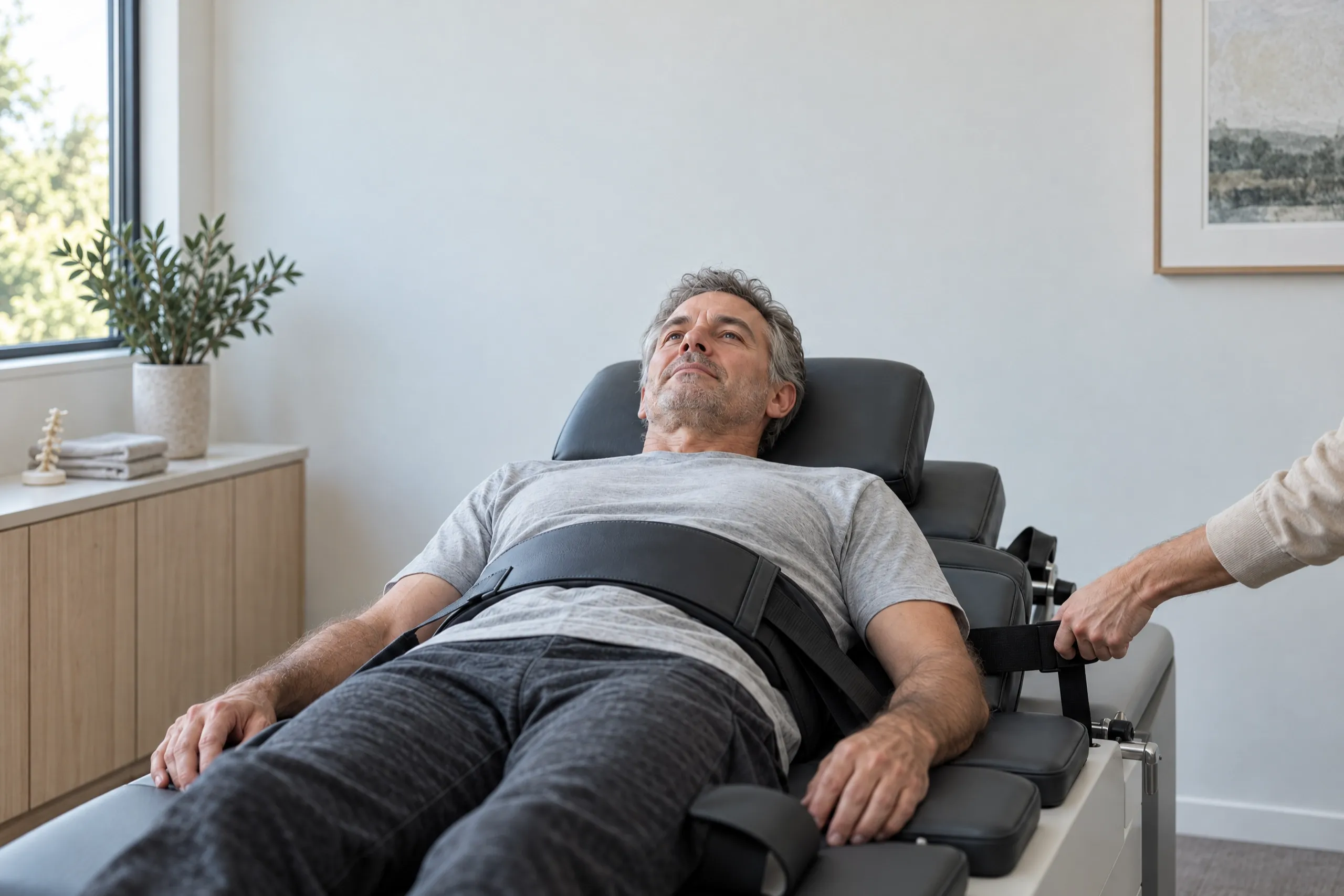
Spinal Decompression Therapy
Computer-controlled traction that eases pressure on compressed discs and the nerves around them.
- No Surgery or Drugs
- Zero Downtime
- Targets the Disc
Explore More Related Treatments
Chiropractic Adjustments
Precise Gonstead adjustments for structural and postural correction, without drugs or surgery.
- Same-Day Relief
- Segment-Specific
- No Downtime
Explore More Related Treatments
Laser Therapy for Pain with Emvital
Relief for muscle and joint pain
- Drug-Free Relief
- No Downtime
- Comfortable Warmth
Explore More Related Treatments
Electrotherapy
Gentle electrical stimulation that calms pain signals and eases muscle tension.
- No Medication
- Comfortable Session
- No Downtime



Your Questions
Frequently Asked Questions
Can spinal arthritis be reversed?
Why is my back stiffest in the morning?
How is this different from rheumatoid arthritis?
How long before I notice a difference?
Is chiropractic care safe with arthritic joints?
What can I do at home between visits?
Do I need an MRI before treatment?
Contact Us
Schedule Your Consultation
Scientific References
- Kalichman et al., Semin Arthritis Rheum. (2007). Review of lumbar facet joint osteoarthritis, its prevalence, imaging findings and association with low back pain. PMID: 17379279.
- Kalichman et al., Spine. (2008). Facet joint osteoarthritis was highly prevalent in a community-based population and increased markedly with age. PMID: 18923337.
- Gellhorn et al., Nat Rev Rheumatol. (2013). Review of osteoarthritis of the spine and the role of the facet joints in degenerative spinal pain. PMID: 23147891.
- Goode et al., Curr Rheumatol Rep. (2013). Examines how low back pain and lumbar spine osteoarthritis are related across imaging and clinical findings. PMID: 23307577.
- Hayden et al., Cochrane Database Syst Rev. (2021). Exercise therapy produced small improvements in pain and function for chronic low back pain compared with no treatment. PMID: 34580864.
- Qaseem et al., Ann Intern Med. (2017). Clinical practice guideline on noninvasive treatments for acute, subacute and chronic low back pain recommends non-drug care first. PMID: 28192789.
- National Institute of Arthritis and Musculoskeletal and Skin Diseases. (2023). Overview of osteoarthritis describing cartilage loss, bone changes and joint stiffness.