

Sciatica Treatment in Camarillo, CA
Relieve Radiating Leg Pain
- Common In:
- Adults 30 to 65
- Primary Causes:
- Disc Herniation, Stenosis
- Treatment Time:
- 20-40 minutes
- Results:
- Often 2 to 8 weeks


What Is Sciatica?
Recognizing the Signs
Sciatica is not a diagnosis by itself. It is a pattern of symptoms produced when the sciatic nerve, or one of the lumbar and sacral nerve roots that form it, is compressed or chemically irritated. Pain follows the path of that nerve from the lower back through the buttock and down the leg, usually on one side.
When you feel a sharp, electric line of pain running from your low back into the buttock and down the back of the thigh, often paired with numbness, pins and needles, or a foot that feels heavy, that is the pattern most people call sciatica. Coughing, sneezing, and long stretches of sitting typically make it louder.
Patients who come to us in Camarillo describe losing sleep, cutting a drive to Thousand Oaks or Oxnard short, and eating standing up because sitting is unbearable. Sciatica treatment works best when it starts with the same question we ask at every first visit: which structure is pressing on the nerve, and what will take that pressure off without surgery?
Why Sciatica Happens
Understanding the Root Causes
01The Science
The sciatic nerve is the longest and thickest nerve in the body, formed where the L4, L5, S1, S2, and S3 nerve roots join near the base of the spine. Each root leaves the spinal canal through a small bony opening, and that opening is where trouble usually starts. Population studies put the lifetime prevalence of sciatica somewhere between 10% and 40%, and the National Library of Medicine lists lumbar disc problems as the most common source.
Two things hurt the nerve at once. The first is mechanical: a bulging disc, a narrowed canal, or a slipped vertebra physically crowds the root. The second is chemical: the inner disc material that leaks out is inflammatory, so the nerve becomes swollen and hypersensitive even where the physical squeeze is modest. That combination explains why a small disc bulge can produce severe leg pain while a larger one causes almost none, a point the National Institute of Neurological Disorders and Stroke makes in its patient material on back pain.
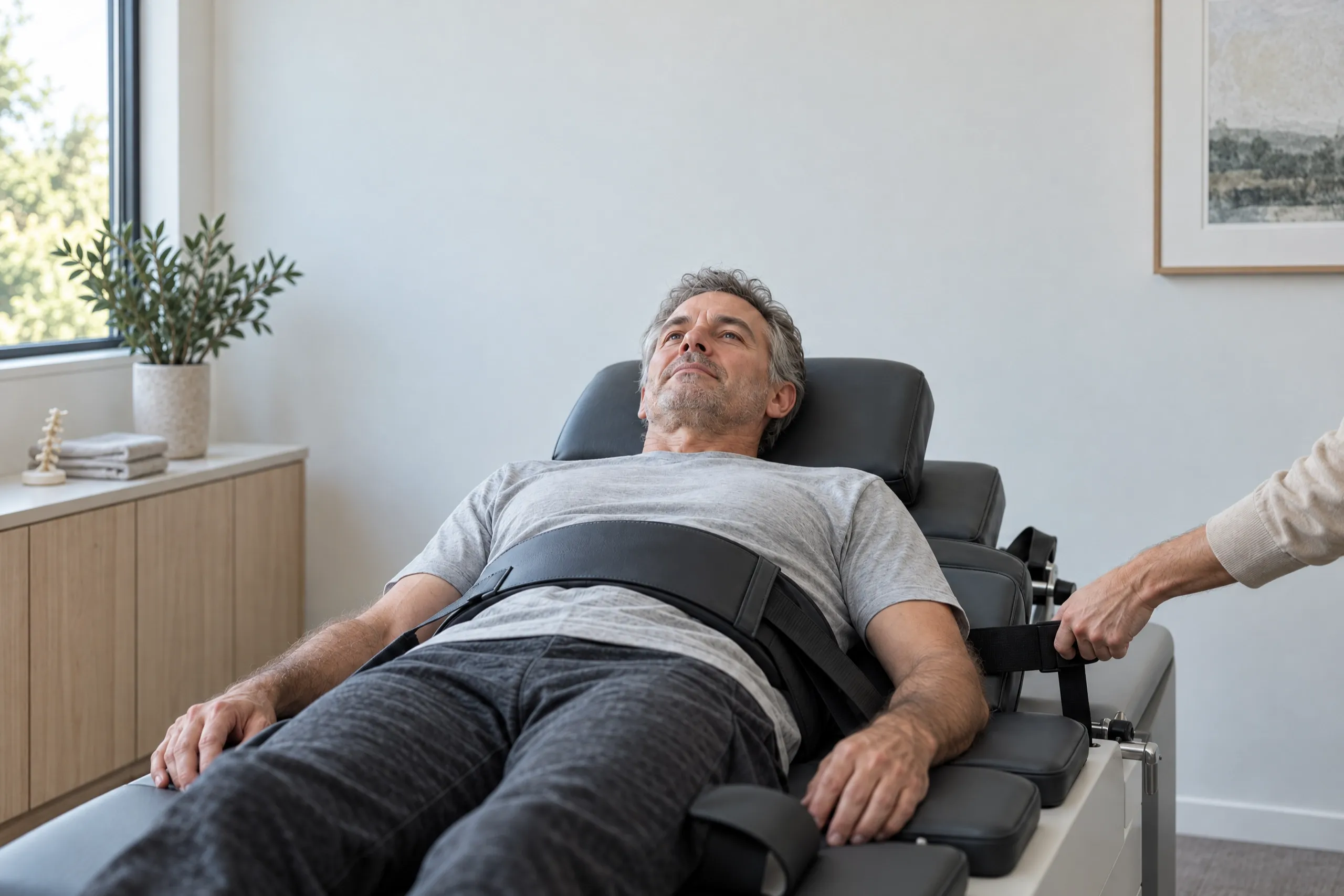
That is also why care aimed at the nerve itself tends to work better than care aimed only at the sore muscles around it. Non-surgical spinal decompression uses computer-controlled traction to lower pressure inside the disc so the bulge can retract away from the root, while inflammation is addressed alongside it. Most people with sciatica improve without an operation, and studies suggest that one to two years out, conservative care and surgery reach broadly similar outcomes for many patients.
02Deeper Understanding
Nerve Root Pressure and Red Flags
When Sciatica Needs Urgent Care
Each lumbar nerve root exits through a gap roughly the width of a pencil eraser, shared with blood vessels and a sleeve of protective tissue. Disc height loss, arthritic bone growth, and swelling all shrink that gap. Because the root also carries motor fibers, sustained pressure can show up as weakness in the calf, the big toe, or the muscles that lift the front of the foot, not only as pain.
Some symptoms are an emergency, not an appointment. Loss of bowel or bladder control, new numbness across the saddle area of the inner thighs and groin, or leg weakness that is rapidly getting worse in both legs can signal cauda equina syndrome, a compression of the nerve bundle at the base of the spinal cord. Go to an emergency department immediately. Do not wait to be seen at a chiropractic office, and do not wait until morning. Severe pain with fever, unexplained weight loss, or a history of cancer also needs medical evaluation first.
Outside of those red flags, the large majority of sciatica is mechanical and responds to conservative care. We begin by mapping which root is involved using orthopedic and neurological testing, then match the plan to the finding, whether that is pinched nerve treatment for a compressed root or decompression for a disc-driven case. If you want a deeper explanation of how each symptom maps to its cause, our article on sciatica symptoms, causes, and relief walks through it in plain language.
What Causes Sciatica?
Sciatica is a symptom with several possible sources, and the right treatment depends entirely on which one you have. These are the causes we see most often at our Camarillo office.
- 01Lumbar Disc HerniationA tear in the tough outer disc wall lets soft inner material press against an L4, L5, or S1 nerve root. This is the most common source of true sciatica.
- 02Spinal StenosisNarrowing of the central canal or the side channels crowds the roots. It is why walking or standing hurts and leaning forward over a cart brings relief.
- 03SpondylolisthesisOne vertebra slips forward over the one beneath it, shrinking the opening the nerve root travels through and loading the joints behind it.
- 04Piriformis SyndromeA tight piriformis muscle deep in the buttock presses the sciatic nerve outside the spine, producing leg pain with no disc involvement at all.
- 05Degenerative Disc ChangesDiscs lose height and water content over the years, which narrows the exit canals and leaves the nerve root less room to glide as you move.
- 06Daily Load and PostureLong commutes, desk hours, repeated bending and lifting, and extra abdominal weight all raise pressure inside the lumbar discs over time.

Why Choose Camarillo Spine & Nerve Institute for Sciatica Care in Camarillo, CA
Dr. Edmond Dooman, DC has spent over 32 years caring for spine and nerve patients in Ventura County, and the practice has served Camarillo since February 1994. Sciatica care here starts with finding the structure causing the pain, not with a generic protocol.
- Cause-First Evaluation
- Orthopedic and neurological testing identifies which nerve root is involved before any treatment plan is written.
- Gonstead Adjusting Method
- Dr. Dooman uses the Gonstead Method, a specific, hands-on approach to restoring motion at the segment that is actually restricted.
- Non-Surgical Options
- Decompression, laser, and electrotherapy are combined so care can address both the mechanical pressure and the inflammation.
- Honest Expectations
- You will hear what conservative care can and cannot do for your case, including when imaging or a medical referral is the right next step.
Treatment Options Comparison
Compare the non-surgical options we use for sciatica so you can see how they differ before your consultation.
| Treatment | Best For | Session Time | Results Timeline | Maintenance |
|---|---|---|---|---|
| Spinal Decompression Therapy | Disc-related nerve pressure | 20-30 min | 2-6 weeks | Periodic sessions |
| Chiropractic Adjustments | Restricted spinal motion | 10-20 min | 1-4 weeks | As needed |
| Pinched Nerve Treatment | Compressed nerve roots | 20-40 min | 2-8 weeks | Periodic sessions |
| Electrotherapy | Muscle guarding and pain flares | 15-20 min | Often same day | Paired with visits |
Signs You May Be Dealing With Sciatica
These are the signs patients most often describe before starting sciatica treatment. If you also notice loss of bowel or bladder control, numbness in the saddle area, or rapidly worsening weakness in both legs, seek emergency care immediately rather than booking a visit.
One-Sided Leg Pain
Pain runs down one leg rather than sitting evenly across your low back, and it follows a narrow line you could trace with a finger.
Pain Below the Knee
The ache travels past the knee into the calf, ankle, or foot, which usually points to a nerve root rather than a strained muscle.
Numbness or Tingling
Parts of the leg or foot feel prickly, buzzing, or asleep, sometimes in a patch you can outline on your skin.
Worse With Sitting
Long drives, desk work, and low couches flare the pain, while standing or walking briefly eases it before it returns.
Weakness in the Foot
You catch a toe on stairs, struggle to push off, or feel the foot slapping down when you walk, which suggests motor fibers are involved.
Pain That Wakes You
Rolling over at night sends a jolt down the leg, and you find yourself stacking pillows to keep the hip from lighting up.
Explore More Related Treatments
Spinal Decompression Therapy
Computer-controlled traction that eases pressure on compressed discs and the nerves around them.
- No Surgery or Drugs
- Zero Downtime
- Targets the Disc
Explore More Related Treatments
Chiropractic Adjustments
Precise Gonstead adjustments for structural and postural correction, without drugs or surgery.
- Same-Day Relief
- Segment-Specific
- No Downtime
Explore More Related Treatments
Peripheral Neuropathy Treatment
Drug-free, non-surgical care for the numbness, burning, and tingling of nerve damage.
- Drug-Free Approach
- No Downtime
- Non-Invasive Care
Explore More Related Treatments
Pinched Nerve Treatment
Non-surgical care that relieves pressure on compressed, irritated nerves.
- Drug-Free Relief
- No Downtime
- Targeted Decompression



Your Questions
Frequently Asked Questions
What is the best treatment for sciatica?
How long does sciatica take to improve?
Can a chiropractor help with sciatica?
Does sciatica treatment hurt?
When is sciatica a medical emergency?
Do I need an MRI before starting treatment?
How much does sciatica treatment cost in Camarillo?
Contact Us
Schedule Your Consultation
Scientific References
- Konstantinou et al., Spine (Phila Pa 1976). (2008). A review of epidemiological studies reported wide variation in sciatica prevalence estimates across populations and definitions. PMID: 18923325.
- Peul et al., N Engl J Med. (2007). Early surgery and prolonged conservative care for sciatica produced similar outcomes at one year, though surgery relieved leg pain faster. PMID: 17538084.
- Weinstein et al., JAMA. (2006). Surgical vs nonoperative treatment for lumbar disk herniation in the Spine Patient Outcomes Research Trial (SPORT), a randomized trial, showed substantial improvement in both groups. PMID: 17119140.
- Qaseem et al., Ann Intern Med. (2017). The American College of Physicians guideline recommends noninvasive, nondrug treatments as the first approach for most low back pain. PMID: 28192789.
- Paige et al., JAMA. (2017). A systematic review and meta-analysis associated spinal manipulative therapy with modest improvements in pain and function for acute low back pain. PMID: 28399251.
- Apfel et al., BMC Musculoskelet Disord. (2010). Restoration of disk height through non-surgical spinal decompression is associated with decreased discogenic low back pain in this retrospective cohort study. PMID: 20615252.