

Failed Back Surgery Syndrome Treatment in Camarillo, CA
Honest answers when the pain came back
- Common In:
- Adults 40 to 75 who had lumbar surgery 6 months to 20 years ago
- Primary Causes:
- Scar tissue, adjacent segment wear, recurrent herniation, hardware irritation
- Treatment Time:
- 10 to 30 minute visits, scheduled after your imaging and reports are reviewed
- Results:
- Varies by case. Some post-surgical spines are not candidates and are told so


What Is Failed Back Surgery Syndrome?
Recognizing the Signs
Failed back surgery syndrome, also called post-laminectomy syndrome, describes back or leg pain that persists or returns after one or more spine operations. The name is unkind and misleading. It does not mean your surgeon failed, and in most cases it does not mean anything was done wrong. Surgery can decompress a nerve or stabilize a segment beautifully and still leave pain behind, because pain has more sources than the one structure the operation addressed.
When you live with it, the story is usually familiar. The first weeks after surgery felt better, then the ache crept back into the low back, or the leg started burning again, or a new pain appeared one level higher than the old one. You may have been told the imaging looks fine, which is confusing when your body clearly does not feel fine.
Care at our Camarillo practice starts with reading your operative reports and imaging, not with a treatment table. Some post-surgical spines respond well to conservative care such as non-surgical spinal decompression, and some do not. If you have fusion instrumentation, rods, screws, cages, an artificial disc or an implanted stimulator, you need an individual assessment and clearance before any decompression is even considered.
Why Pain Returns After Spine Surgery
Understanding the Root Causes
01The Science
A spine operation treats one problem at one place. It does not stop the rest of the spine from aging, and it does not erase the changes that long-standing pain has already made in the nervous system. The National Institute of Neurological Disorders and Stroke notes that chronic back pain is frequently multifactorial, which is exactly why a technically successful operation can still leave symptoms behind.
Three mechanisms account for most cases. Epidural fibrosis, the scar tissue that forms as the surgical site heals, can tether a nerve root so that ordinary bending tugs on it. Adjacent segment degeneration means the levels directly above or below a fusion now absorb motion the fused level no longer shares, and studies report meaningful rates of new symptoms at those neighboring levels within a decade. Recurrent or residual disc material can compress the same root a second time.
There is a fourth contributor that imaging never shows. Central sensitization is the process by which months or years of pain signaling lowers the alarm threshold in the spinal cord and brain, so smaller inputs produce larger pain. That is why two people with identical post-operative scans can report very different symptoms, and why conditions like degenerative disc disease often travel alongside this diagnosis.
02Deeper Understanding
Scar Tissue, Hardware and the Levels Next Door
How Post-Surgical Changes Shape Your Symptoms
Epidural fibrosis is normal healing in an abnormal place. Collagen lays down around the operated nerve root the way it would in any wound, but here the scar can bind the root to the surrounding tissue. The nerve loses its small amount of normal glide, so flexing forward or straightening the leg pulls on a structure that no longer slides freely. Patients usually describe this as a pulling or burning that is worse with sustained positions than with rest.
Hardware behaves differently. Fusion instrumentation does its job by removing motion from a segment, and that motion has to be absorbed somewhere. The disc and facet joints immediately above the construct take on extra load, wear faster and can begin producing the same symptoms that prompted the first surgery. Occasionally the hardware itself becomes the irritant through loosening, prominence under thin tissue, or contact with a nerve root.
Muscle matters too. Surgical exposure, bracing and months of guarding leave the deep trunk stabilizers weak and slow to fire, which loads the spine poorly for every hour you are upright. Rebuilding that support, sometimes with core strengthening with Emsculpt Neo alongside hands-on care, is often as important as anything done to the painful segment itself. Suitability for that device is also reviewed against your implant history.
What Contributes to Failed Back Surgery Syndrome?
Several factors can keep pain going after spine surgery, and most patients have more than one. MedlinePlus offers a plain-language overview of back pain for context.
- 01Epidural FibrosisScar tissue from healing tethers the nerve root so normal bending and leg movement tug on a structure that can no longer glide.
- 02Adjacent Segment DegenerationLevels above or below a fusion absorb the motion the fused segment no longer shares, and wear out faster as a result.
- 03Recurrent HerniationDisc material can protrude again at the operated level, compressing the same nerve root months or years after the first procedure.
- 04Incomplete DecompressionA narrowed lateral recess or a second contributing level can be left behind, so one source of nerve pressure is relieved and another is not.
- 05Hardware IssuesLoosened, prominent or poorly tolerated instrumentation can irritate nearby tissue and produce pain that is unrelated to the original disc.
- 06Central SensitizationLong-standing pain lowers the nervous system alarm threshold, so ordinary movement is felt as pain even when the surgery site healed well.
- 07DeconditioningMonths of guarding and reduced activity weaken the deep trunk muscles, leaving the spine poorly supported through every upright hour.

Why Choose Camarillo Spine & Nerve Institute for Failed Back Surgery Care in Camarillo, CA
Dr. Edmond Dooman, DC has cared for spine patients in Ventura County since the practice opened in February 1994, more than 32 years of clinical experience. Post-surgical spines are assessed individually: operative reports and imaging are reviewed before any treatment plan is offered, and patients who are not candidates are told so plainly.
- Records Reviewed First
- Your operative report, hardware details and most recent imaging are read before any table time is scheduled.
- Honest Candidacy Answers
- Some post-surgical spines are not suitable for decompression. If yours is one of them, you will hear that directly.
- Non-Surgical Focus
- Care is drug-free and non-surgical, combining hands-on Gonstead method adjustments with device-based therapies where appropriate.
- Clear Referral Boundaries
- New neurological deficit, hardware failure or red flag findings are referred back to your surgeon rather than treated here.
Treatment Options Comparison
Every option below depends on individual clearance. Spinal hardware can rule some of them out entirely.
| Treatment | Best For | Session Time | Results Timeline | Hardware Consideration |
|---|---|---|---|---|
| Spinal Decompression Therapy | Disc-related leg pain | 20 to 30 minutes | Often 4 to 8 weeks | Clearance required, hardware may exclude |
| Chiropractic Adjustments | Stiff segments near a fusion | 10 to 20 minutes | Often within weeks | Levels selected around instrumentation |
| Electrotherapy | Muscle guarding and flares | 15 to 20 minutes | Often felt same day | Not used with implanted stimulators |
| Laser Therapy for Pain with Emvital | Deep muscle stiffness and scar-area soreness | 10 to 20 minutes | Often felt same visit | Reviewed case by case |
| Core Strengthening with Emsculpt Neo | Weak trunk support after surgery | About 30 minutes | Typically 6 to 12 weeks | Metal implants must be screened |
Signs You May Be Living With Failed Back Surgery Syndrome
If several of these describe your months since surgery, the pattern is worth a professional look. One caution first: new or worsening weakness, numbness, foot drop, or any change in bladder or bowel control after spine surgery belongs with your operating surgeon, not a chiropractor. Those are surgical questions and we will send you straight back.
Pain That Came Back
You felt genuinely better for weeks or months after surgery, then the familiar ache returned without a new injury to explain it.
Leg Pain Again
Burning, shooting or aching travels below the knee much as it did before, which overlaps with sciatica symptoms.
Pain at a New Level
The soreness now sits above or below the operated area, which can point toward the segment next to a fusion.
Worse With Sitting
Long drives on the 101 and desk hours provoke it, while standing and walking short distances feel comparatively easier.
Morning Stiffness
The first thirty minutes of the day are rigid and guarded, and it takes deliberate movement before you feel loose.
Normal Imaging, Real Pain
You were told the post-operative scan looks acceptable, yet daily life still revolves around managing symptoms.
Medication Fatigue
You are tired of relying on pain medication for function and want to understand what non-surgical options actually apply to you.
Explore More Related Treatments
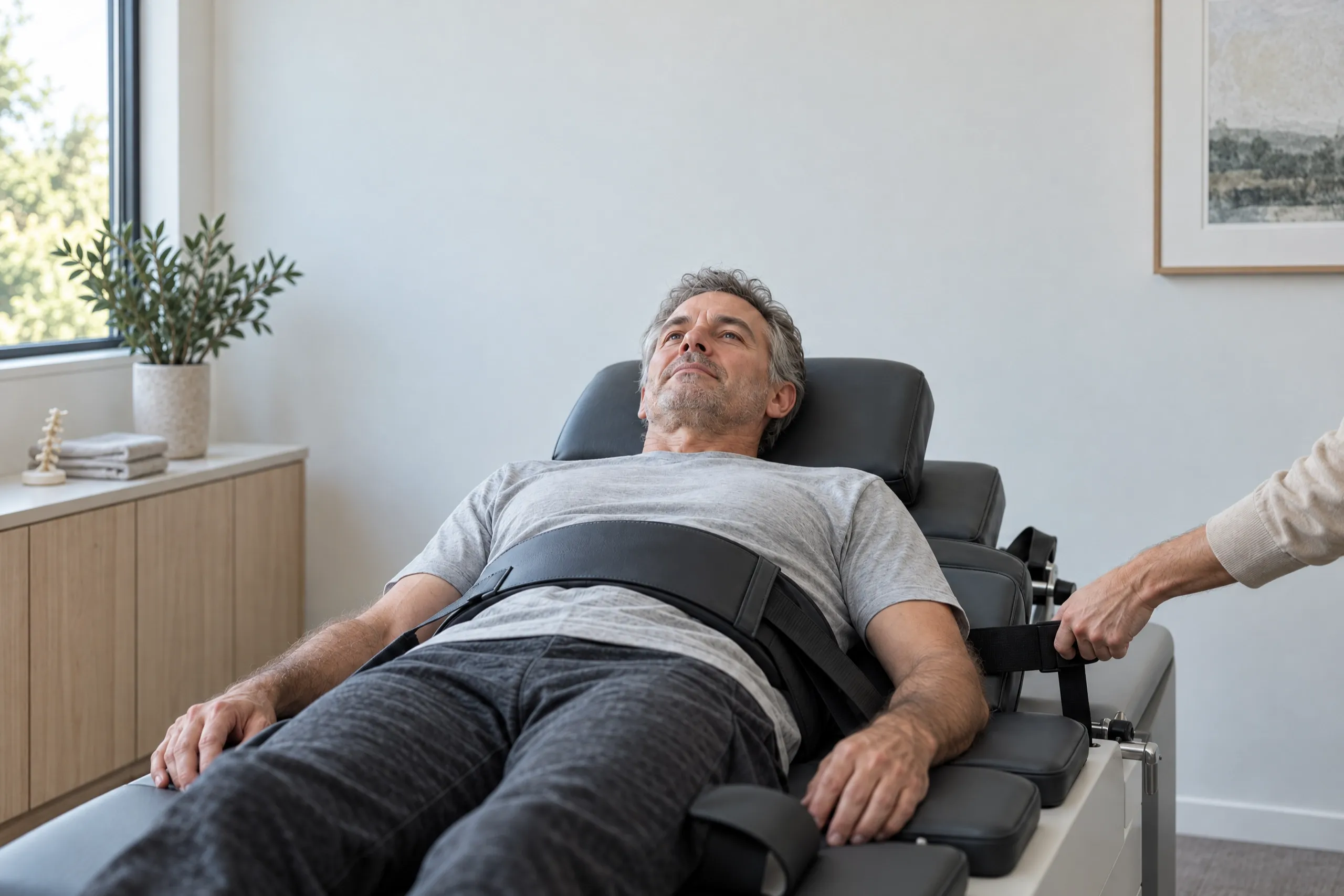
Spinal Decompression Therapy
Computer-controlled traction that eases pressure on compressed discs and the nerves around them.
- No Surgery or Drugs
- Zero Downtime
- Targets the Disc
Explore More Related Treatments
Chiropractic Adjustments
Precise Gonstead adjustments for structural and postural correction, without drugs or surgery.
- Same-Day Relief
- Segment-Specific
- No Downtime
Explore More Related Treatments
Laser Therapy for Pain with Emvital
Relief for muscle and joint pain
- Drug-Free Relief
- No Downtime
- Comfortable Warmth
Explore More Related Treatments
Electrotherapy
Gentle electrical stimulation that calms pain signals and eases muscle tension.
- No Medication
- Comfortable Session
- No Downtime



Your Questions
Frequently Asked Questions
Does failed back surgery syndrome mean my surgeon did something wrong?
Can I have spinal decompression if I have rods, screws or a fusion?
What should I bring to a first visit after spine surgery?
My leg weakness and numbness are getting worse. What should I do?
Why does my pain now sit above my old surgery site?
What does care cost and is insurance billed?
Contact Us
Schedule Your Consultation
Scientific References
- Daniell et al., Asian Spine J. (2018). Failed back surgery syndrome review article covering the structural and non-structural factors that keep pain going after lumbar surgery. PMID: 29713421.
- Papalia et al., Global Spine J. (2023). Systematic review of non-invasive treatments studied for failed back surgery syndrome. PMID: 36412047.
- Michael et al., J Neurosurg Spine. (2019). Reports adjacent-segment disease following two-level axial lumbar interbody fusion. PMID: 31003221.
- Aizawa et al., J Orthop Sci. (2012). Twenty-year study of reoperation for recurrent lumbar disc herniation in a Japanese population. PMID: 22189996.
- Sanzarello et al., J Back Musculoskelet Rehabil. (2016). Narrative review of central sensitization in chronic low back pain and how it sustains symptoms. PMID: 27062464.
- Samy Abdou et al., Neurol Res. (1999). Describes epidural fibrosis and the failed back surgery syndrome, including history and physical findings. PMID: 10214565.