

Back Pain Treatment in Camarillo, CA
Move Through Your Day With Less Pain
- Common In:
- Adults 30 and older
- Primary Causes:
- Discs, Joints, Muscle Strain
- Treatment Time:
- 15-30 minutes
- Results:
- Days to several weeks


What Is Back Pain?
Recognizing the Signs
Back pain is discomfort anywhere along the spine, from the base of the neck to the tailbone, that comes from the discs, the facet joints, the surrounding muscles and ligaments, or the nerve roots that exit between the vertebrae. It is one of the most common reasons adults visit a healthcare provider, and most cases are mechanical rather than the result of serious disease.
When you feel a dull ache across your lower back after sitting through a commute on the 101, a catch between the shoulder blades when you reach overhead, or a sharp stab when you stand up from the couch, you are feeling irritated tissue and protective muscle guarding working together. The pain may stay in one spot or travel into the hip, buttock or leg.
Many patients in Camarillo describe it as a pain that never fully goes away. It quiets down for a week, then returns after a long drive, a weekend of yard work or a bad night of sleep. That pattern of flare and calm is worth taking seriously, because it usually means the underlying mechanical problem has not been addressed.
Why Back Pain Happens
Understanding the Root Causes
01The Science
Each spinal disc is a pressurized cushion with a tough outer ring and a gel-like center that is roughly 80 percent water in early adulthood. That water content drops steadily with age, so the disc flattens, absorbs less load and lets the vertebrae sit closer together. The National Institute of Neurological Disorders and Stroke notes that most low back pain is mechanical in origin and improves with conservative care rather than surgery.
As disc height is lost, the small facet joints at the back of each spinal segment take on load they were never designed to carry. Those joints are densely supplied with pain fibers, which is why a seemingly small movement can produce a large amount of pain. The muscles around the segment then tighten to protect it, and that guarding adds its own ache on top of the original problem.
When a disc bulges or the joint space narrows, the nerve root leaving that level can become compressed or chemically irritated, which is how back pain starts referring into the buttock and leg. Reducing that pressure is the goal of non-surgical spinal decompression, which uses computer-controlled traction to gently open the disc space.
02Deeper Understanding
Discs, Nerves and Core Support
How Structure Affects Daily Comfort
The spine does not hold itself upright on bone alone. The deep abdominal wall, the multifidus muscles running alongside the vertebrae and the pelvic floor act as a pressurized canister that shares load with the discs. When that system weakens after an injury, a pregnancy or years of desk work, the discs and joints absorb more force with every bend and lift.
Pain itself accelerates the weakening. Within days of a flare, the deep stabilizing muscles switch on later and less completely, so the segment that already hurts gets even less protection. That is why some people recover movement but keep re-injuring the same spot. Rebuilding that support with core strengthening with Emsculpt Neo addresses the stability side of the problem rather than the symptom alone.
Back pain also overlaps with conditions that deserve their own evaluation. Pain that runs below the knee may be sciatica, a soft disc pressing on a nerve root may be a herniated or bulging disc, and a forward head and rounded shoulders may point to poor posture as the driver. Our guide to relieving lower back pain without surgery walks through what conservative care typically involves.
What Makes Back Pain Worse?
Several everyday factors keep back pain going, usually in combination rather than alone. Recognizing yours makes it far easier to break the flare and calm cycle.
- 01Prolonged SittingLong commutes and desk hours raise disc pressure and shorten the hip flexors, which tips the pelvis and loads the lower back.
- 02Repetitive LiftingBending and twisting under load, at work or in the garden, strains the outer disc wall and the facet joints repeatedly.
- 03Deconditioned CoreWeak deep abdominal and spinal muscles leave each segment to absorb force that the muscular system should be sharing.
- 04Past Injury or CollisionAn old fall or car accident can leave altered movement patterns that overload one spinal level for years afterward.
- 05Excess Body WeightAdded load through the abdomen shifts the center of gravity forward and increases compressive force on the lumbar discs.
- 06Stress and Poor SleepElevated stress raises muscle tone and lowers pain tolerance, while broken sleep slows the tissue repair that normally happens overnight.

Why Choose Camarillo Spine & Nerve Institute for Back Pain Care in Camarillo, CA
Dr. Edmond Dooman, DC has cared for back pain patients in Ventura County since founding the practice in February 1994, with over 32 years of clinical experience and the Gonstead Method guiding his adjustments. Care here is non-surgical and drug-free, and it starts with finding which structure is actually generating your pain.
- Specific Diagnosis First
- We examine the spine segment by segment to identify the disc, joint or nerve root driving your pain before treating it.
- Gonstead Method Adjustments
- Dr. Dooman uses the Gonstead approach, a precise, segment-specific technique rather than a generic full-spine adjustment.
- Non-Surgical Technology
- Spinal decompression, laser and electrotherapy units let us match the therapy to the tissue instead of forcing one approach.
- Honest About Outcomes
- We tell you what conservative care can and cannot do, and we refer out when your symptoms call for medical imaging or evaluation.
Treatment Options Comparison
Compare the non-surgical options we offer for back pain so you can see how they differ in focus and timeline.
| Treatment | Best For | Session Time | Results Timeline | Maintenance |
|---|---|---|---|---|
| Chiropractic Adjustments | Restricted, painful segments | 10-15 minutes | Often same visit | As symptoms require |
| Spinal Decompression Therapy | Disc-related pain and leg symptoms | 20-30 minutes | Several weeks | Periodic sessions |
| Laser Therapy for Pain with Emvital | Deep muscle and joint stiffness | 10-20 minutes | Often within two to four sessions | As symptoms return |
| Core Strengthening with Emsculpt Neo | Weak core and recurring flares | 30 minutes | Four to twelve weeks | Occasional top-ups |
You May Be Experiencing Back Pain If...
Recognizing your pattern helps you decide when self-care is enough and when an evaluation is the better next step. Most back pain is mechanical and many patients start with chiropractic adjustments in Camarillo, CA. Seek same-day medical care instead for loss of bladder or bowel control, numbness in the groin or inner thighs, worsening leg weakness, fever, unexplained weight loss or pain after a fall or collision.
Morning Stiffness
Your back feels locked for the first 20 to 30 minutes of the day and only loosens once you have been moving.
Pain After Sitting
Standing up from the car or a desk chair produces a sharp catch and you need a moment before you can straighten fully.
Pain Into the Hip or Leg
The ache travels from your lower back into the buttock, and sometimes down the back of the thigh past the knee.
Recurring Flares
The same spot goes out several times a year, triggered by lifting, yard work or an ordinary movement like reaching for a shoe.
Numbness or Tingling
Pins and needles or patches of numbness appear in the leg or foot, which suggests a nerve root is being irritated.
Disrupted Sleep
You wake when you roll over, or you cannot find a position that lets the back settle for more than an hour or two.
Explore More Related Treatments
Spinal Decompression Therapy
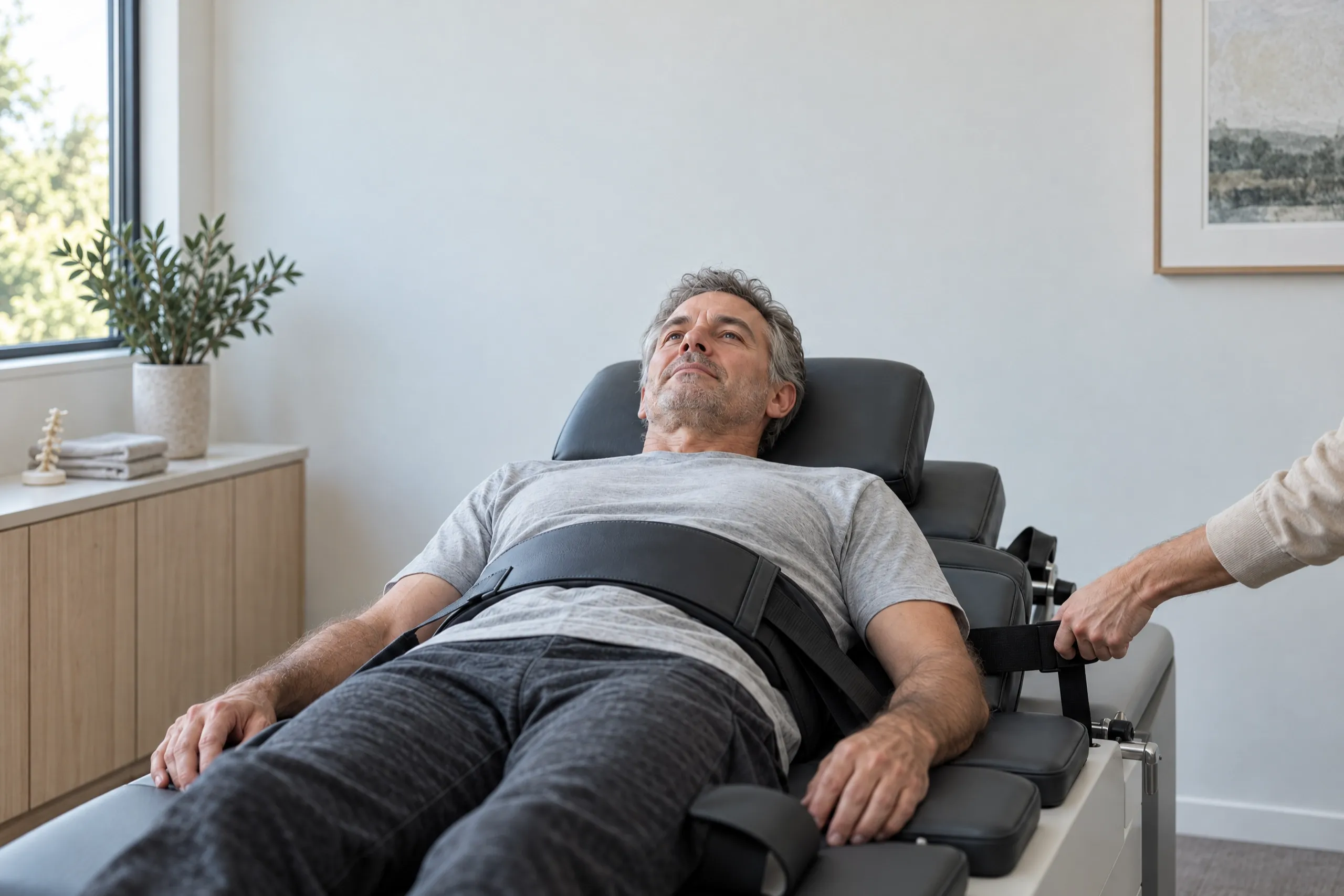
Computer-controlled traction that eases pressure on compressed discs and the nerves around them.
- No Surgery or Drugs
- Zero Downtime
- Targets the Disc
Explore More Related Treatments
Chiropractic Adjustments
Precise Gonstead adjustments for structural and postural correction, without drugs or surgery.
- Same-Day Relief
- Segment-Specific
- No Downtime
Explore More Related Treatments
Laser Therapy for Pain with Emvital
Relief for muscle and joint pain
- Drug-Free Relief
- No Downtime
- Comfortable Warmth
Explore More Related Treatments
Electrotherapy
Gentle electrical stimulation that calms pain signals and eases muscle tension.
- No Medication
- Comfortable Session
- No Downtime



Your Questions
Frequently Asked Questions
How long should back pain last before I get it checked?
When is back pain a medical emergency?
Can back pain be treated without surgery or medication?
How do I know which treatment is right for my back pain?
How quickly will I feel a difference?
What can I do at home between visits?
Do you take insurance for back pain care?
Contact Us
Schedule Your Consultation
Scientific References
- Qaseem A et al., Annals of Internal Medicine. (2017). Clinical practice guideline recommending noninvasive, nonpharmacologic treatments first for acute, subacute and chronic low back pain. PMID: 28192789.
- Paige NM et al., JAMA. (2017). Association of spinal manipulative therapy with clinical benefit and harm for acute low back pain, a systematic review and meta-analysis. PMID: 28399251.
- Rubinstein SM et al., BMJ. (2019). Systematic review of randomised trials reporting benefits and harms of spinal manipulative therapy for chronic low back pain. PMID: 30867144.
- Hartvigsen J et al., Lancet. (2018). Analysis of what low back pain is and why it is the leading global cause of years lived with disability. PMID: 29573870.
- Foster NE et al., Lancet. (2018). Review of prevention and treatment of low back pain, evidence, challenges and promising directions. PMID: 29573872.
- Chou R et al., Annals of Internal Medicine. (2017). Nonpharmacologic therapies for low back pain, a systematic review for an American College of Physicians clinical practice guideline. PMID: 28192793.