

Muscle and Joint Pain Treatment in Camarillo, CA
Move With Less Pain and Stiffness
- Common In:
- Active adults and 45 plus
- Primary Causes:
- Overuse, joint wear, injury
- Treatment Time:
- 15-30 minutes per visit
- Results:
- Often 4-8 weeks of care


What Is Muscle and Joint Pain?
Recognizing the Signs
Muscle and joint pain is discomfort arising from the musculoskeletal system: the muscles, tendons, ligaments and joint surfaces that move you. It covers myofascial pain and trigger points, tendinopathy from repeated load, osteoarthritis symptoms in worn joints, and the stiffness that lingers after an injury.
When you notice a shoulder that aches through the night, a knee that complains on the stairs, or a band of muscle that stays tight no matter how much you stretch, you are describing this pattern. It often builds slowly, so many patients cannot name the day it started.
Patients in Camarillo commonly describe it as feeling stiff for the first thirty minutes of the morning, sore after yard work or a round of golf, or simply older than they are. The pain rarely stays in one place: a guarded hip changes how you walk, and the low back picks up the extra work.
Why Muscle and Joint Pain Happens
Understanding the Root Causes
01The Science
Healthy joints glide on a thin layer of cartilage kept slick by synovial fluid, and healthy muscle contracts and fully releases. With repeated load, age or injury, cartilage thins, tendons become disorganised rather than simply inflamed, and muscle fibres hold a low-grade contraction they never let go of. The National Institute of Arthritis and Musculoskeletal and Skin Diseases describes osteoarthritis as this gradual loss of cartilage alongside changes in the underlying bone.
Once tissue is irritated, the surrounding muscles splint the area to protect it. That guarding limits motion, and restricted motion loads the joint unevenly, which irritates the tissue again. This is the loop that turns a two-week ache into a two-year one, and it is the loop conservative care is aimed at.
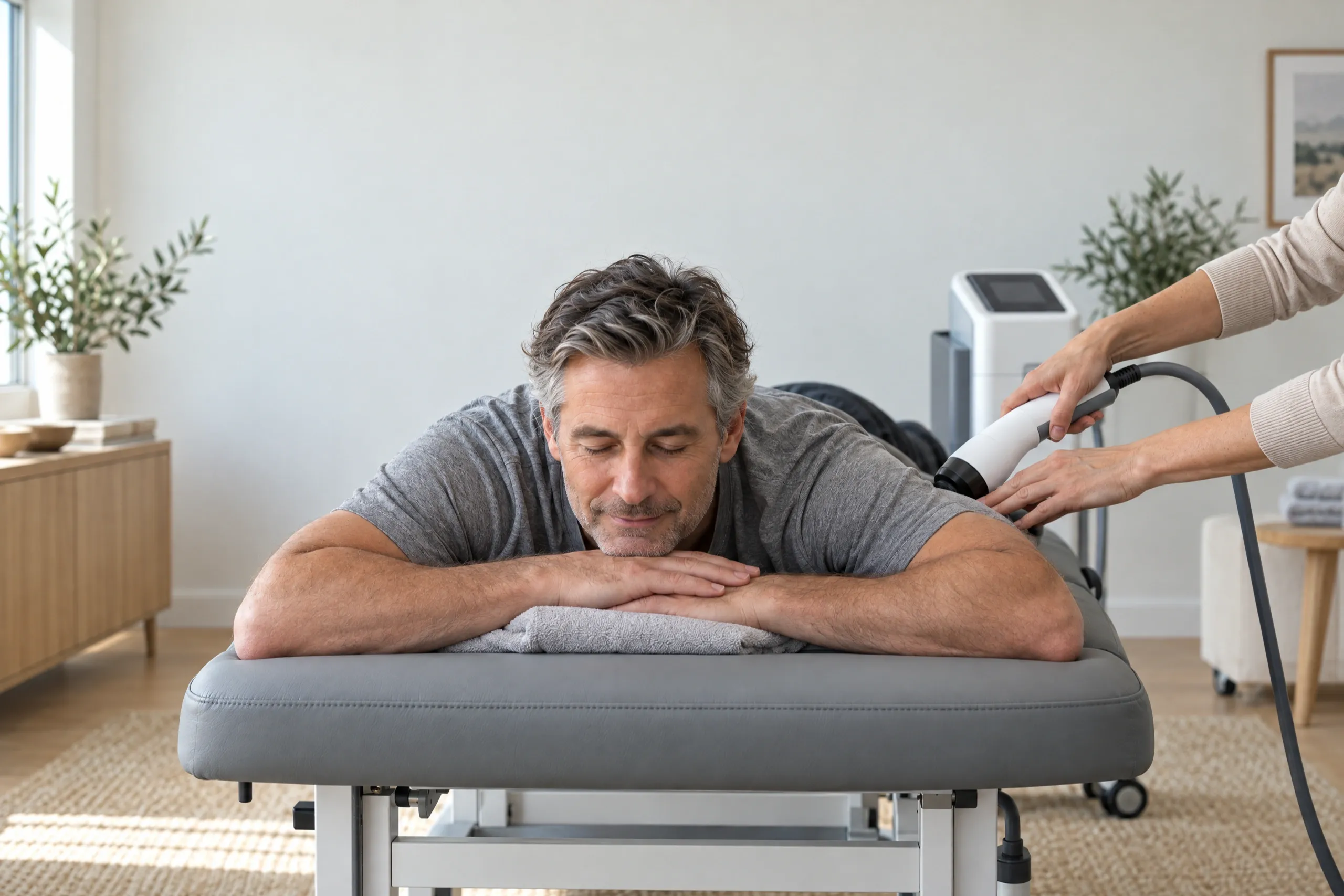
Treatment targets different points in that cycle. Deep tissue laser therapy in Camarillo, CA uses 1064 nm infrared energy to warm tissue several centimetres below the surface, which many patients find eases stiffness and lets a guarded joint move further, while hands-on care restores the motion the joint has lost.
02Deeper Understanding
Trigger Points and Referred Pain
How Tight Muscle Spreads Discomfort
A trigger point is a small, hypersensitive knot inside a taut band of muscle. Press it and it is tender locally, but it also refers pain somewhere else: a knot in the upper trapezius sends ache into the side of the head, one in the gluteus medius sends it down the outside of the thigh. This is why the spot that hurts is often not the spot that is driving it.
Trigger points form where muscle is held under sustained low-level load, which is why desk posture, a repetitive work task or protecting an injured joint all produce them. Blood flow through the knot drops, metabolic by-products accumulate, and the tissue becomes more sensitive rather than less over time.
Because the problem is local blood flow and tissue irritation rather than joint mechanics alone, improving circulation matters here. Laser therapy for pain with Emvital delivers 1064 nm infrared energy as deep warmth, which increases local blood flow and helps tight, irritated soft tissue release. Restricted joints that keep reloading the same muscle are addressed with chiropractic adjustments in Camarillo, CA.
What Makes Muscle and Joint Pain Worse?
Several factors stack on top of each other to keep muscle and joint pain going, and MedlinePlus notes that overuse and strain are among the most common reasons muscles complain. For deconditioned tissue that keeps failing under load, electrical stimulation therapy can be used to fatigue and re-educate the muscle without stressing the joint.
- 01Repetitive OveruseThe same movement performed all day, whether at a keyboard, on a job site or in the garden, loads identical fibres until they stop recovering between sessions.
- 02Age-Related Joint WearCartilage thins and becomes less resilient with the decades, so joints tolerate less load before they ache and stiffen after rest.
- 03Prolonged SittingHours in one position shorten hip flexors and hamstrings and leave shoulder and neck muscles holding a static load they were never built for.
- 04Old InjuriesA sprain or strain that healed with scar tissue and altered movement leaves the joint loading unevenly for years afterwards.
- 05Weekend Load SpikesSitting five days then hiking, surfing or playing eighteen holes on Saturday exposes tissue to far more load than it has been prepared for.
- 06Poor Sleep and StressShort, broken sleep lowers pain tolerance and slows tissue repair, and sustained stress keeps muscle tone elevated around already irritated joints.

Why Choose Camarillo Spine & Nerve Institute for Muscle and Joint Pain Care in Camarillo, CA
Dr. Edmond Dooman, DC has cared for Ventura County patients since the practice opened in February 1994, with over 32 years of clinical experience. For muscle and joint pain the exam comes first: identify which joints have stopped moving, which muscles are guarding them, and which tissue is irritated, then build the plan from that rather than from a fixed package.
- Exam Before Treatment
- The Gonstead Method assesses one joint at a time, so care is aimed at the segments and tissue actually involved.
- Deep Tissue Laser, Used Deliberately
- The 1064 nm Emvital laser delivers deep heat for stiffness and persistent joint pain, and it is only added when the exam shows it fits.
- Non-Surgical and Drug-Free
- Every option here works without injections, prescriptions or surgery, which matters to patients trying to avoid both.
- Honest About Scope
- If your presentation points to inflammatory arthritis or infection rather than mechanical pain, we say so and refer you on.
Treatment Options Comparison
Compare the non-surgical options we use for muscle and joint pain so you can see how they differ.
| Treatment | Best For | Session Time | Results Timeline | Maintenance |
|---|---|---|---|---|
| Laser Therapy for Pain with Emvital | Deep stiffness and joint pain | 10-20 minutes | Often within 2-4 sessions | As symptoms return |
| Electrotherapy | Muscle spasm and guarding | 10-20 minutes | Often same visit relief | Alongside other care |
| Chiropractic Adjustments | Restricted, stiff joints | 10-15 minutes | Often 2-6 visits | Periodic as needed |
You May Be Experiencing Muscle and Joint Pain If...
Recognising the pattern helps you decide when self-care has run its course and a proper exam is the better next step, and the American Chiropractic Association supports conservative care as a first approach for most musculoskeletal pain. A hot, red, swollen joint, joint pain with fever or sudden severe pain with no clear injury needs medical evaluation instead, and we will refer rather than treat.
Morning Stiffness
The first twenty to thirty minutes after waking are the worst part of your day, and movement loosens the joint rather than aggravating it.
Aching After Activity
You pay for yard work, a hike or a long drive the following day with soreness that was not there before.
A Knot That Never Releases
One band of muscle stays tight no matter how much you stretch, foam roll or press on it, and it is tender to touch.
Pain That Moves
The ache refers away from the sore spot, running into the arm, the side of the head or the outside of the thigh.
Losing Range of Motion
Reaching overhead, turning to back the car out or squatting to the bottom shelf is now limited by stiffness rather than strength.
Nothing Sticks
Rest, over-the-counter anti-inflammatories and a heat pack help for a day or two, then the same pain returns unchanged.
Explore More Related Treatments
Laser Therapy for Pain with Emvital
Relief for muscle and joint pain
- Drug-Free Relief
- No Downtime
- Comfortable Warmth
Explore More Related Treatments
Electrotherapy
Gentle electrical stimulation that calms pain signals and eases muscle tension.
- No Medication
- Comfortable Session
- No Downtime
Explore More Related Treatments
Spinal Decompression Therapy
Computer-controlled traction that eases pressure on compressed discs and the nerves around them.
- No Surgery or Drugs
- Zero Downtime
- Targets the Disc
Explore More Related Treatments
Chiropractic Adjustments
Precise Gonstead adjustments for structural and postural correction, without drugs or surgery.
- Same-Day Relief
- Segment-Specific
- No Downtime



Your Questions
Frequently Asked Questions
What does laser therapy do for muscle and joint pain?
How quickly will my muscle and joint pain improve?
Can muscle and joint pain be treated without medication or surgery?
When should I see a doctor instead of coming here?
Can several treatments be combined in one visit?
What can I do at home between visits?
Does insurance cover care for muscle and joint pain?
Contact Us
Schedule Your Consultation
Scientific References
- Chow RT et al., Lancet. (2009). Efficacy of low-level laser therapy in the management of neck pain: a systematic review and meta-analysis of randomised placebo or active-treatment controlled trials. PMID: 19913903.
- Johnson MI et al., BMJ Open. (2022). Efficacy and safety of transcutaneous electrical nerve stimulation (TENS) for acute and chronic pain in adults, a systematic review and meta-analysis of 381 studies, the meta-TENS study. PMID: 35144946.
- Bjordal JM et al., BMC Musculoskelet Disord. (2008). A systematic review with procedural assessments and meta-analysis of low level laser therapy in lateral elbow tendinopathy, tennis elbow. PMID: 18510742.
- Kolasinski SL et al., Arthritis Care Res (Hoboken). (2020). 2019 American College of Rheumatology and Arthritis Foundation Guideline for the Management of Osteoarthritis of the Hand, Hip, and Knee. PMID: 31908149.
- Liu S et al., BMJ Open. (2022). Global burden of musculoskeletal disorders and attributable factors in 204 countries and territories, a secondary analysis of the Global Burden of Disease 2019 study. PMID: 35768100.
- Qaseem A et al., Ann Intern Med. (2017). Noninvasive treatments for acute, subacute and chronic low back pain, a clinical practice guideline from the American College of Physicians. PMID: 28192789.
- National Institute of Arthritis and Musculoskeletal and Skin Diseases. (2023). Overview of osteoarthritis describing cartilage loss, bone changes, joint pain and stiffness.