

Degenerative Disc Disease Treatment in Camarillo, CA
Move Comfortably Again
- Common In:
- Adults 30 and older
- Primary Causes:
- Aging, genetics, repetitive load
- Treatment Time:
- 20-45 minutes
- Results:
- Gradual over 4-12 weeks


What Is Degenerative Disc Disease?
Recognizing the Signs
Degenerative disc disease describes the gradual loss of water content, height and cushioning in the intervertebral discs that sit between your vertebrae. Despite the name, it is not a disease in the usual sense. You do not catch it, you cannot pass it to anyone, and it is not a verdict about your future. It is an age-related change in tissue, closer to gray hair or reading glasses than to an illness.
When you feel a deep ache low in your back after a long drive on the 101, and that ache fades once you get up and walk, you may be feeling a disc that no longer spreads load the way it once did. Many people in Camarillo describe stiffness for the first twenty minutes of the morning that loosens as the day gets going.
The label frightens people more than the finding warrants. The word disease suggests something relentless and destructive, when in practice most degenerated discs never cause meaningful pain, and the pain that does appear often responds well to conservative care.
Why Spinal Discs Degenerate Over Time
Understanding the Root Causes
01The Science
A healthy disc is mostly water, with a gel-like center called the nucleus pulposus that spreads pressure evenly across the vertebra above and below it. Discs lose their direct blood supply in early adulthood, so they depend on fluid moving in and out through the bony endplates as you move and rest. Water content falls steadily from the twenties onward, and with it the disc's ability to absorb shock.
As a disc dries it flattens slightly, and the tough outer ring, the annulus fibrosus, carries load it was never designed to handle alone. Small fissures can form in that ring, the facet joints behind the disc start to bear more weight, and the opening where the nerve root exits narrows a little. That chain of events, rather than the drying itself, is usually what produces symptoms.
Imaging and pain track each other poorly. The National Institute of Arthritis and Musculoskeletal and Skin Diseases notes that most back pain has no single identifiable structural cause, and large imaging reviews find disc degeneration in the majority of adults who have no back pain at all. A degenerated disc on a report is a finding, not a diagnosis.
02Deeper Understanding
Disc Height Loss and Nerve Crowding
How Thinning Discs Affect Nearby Nerves
Each level of your spine works as a three-joint complex: the disc in front and two facet joints behind. Disc height is what keeps the side openings, the intervertebral foramina, wide enough for nerve roots to pass through without pressure.
When a disc loses even two or three millimeters of height, those openings narrow. A crowded nerve root can produce pain, numbness or tingling that travels into the buttock, leg, shoulder or arm, which is why disc degeneration is often mistaken for a purely muscular problem. Non-surgical spinal decompression is built for this situation, using gentle cyclic traction to lower pressure inside the disc space and give the nerve root more room.
The facet joints behind the disc also take on more load as disc height falls, which over years feeds into spinal arthritis and the stiffness that comes with it. Treating the region as a whole, rather than one disc on a scan, generally produces better day to day function.
What Accelerates Disc Degeneration?
Disc degeneration is driven by a mix of factors you cannot change and several you can. Genetics carry more weight than most people expect, but load, movement habits and general health all influence how quickly a disc ages. Chiropractic adjustments in Camarillo, CA address the joint restriction side of that picture.
- 01Age-Related Fluid LossDiscs lose water content steadily from your twenties onward, reducing height and the ability to absorb everyday shock.
- 02Genetic PredispositionTwin and family research suggests inherited factors account for a large share of how early and how fast discs degenerate.
- 03Limited Disc NutritionAdult discs have no direct blood supply and rely on movement to exchange fluid, so long sitting slows their nourishment.
- 04Repetitive LoadingYears of lifting, bending, whole-body vibration from driving or heavy manual work add stress the disc cannot fully repair.
- 05Smoking and Vascular HealthSmoking narrows the small vessels feeding the endplates, which is linked to faster and more widespread disc degeneration.
- 06Excess Load and Weak CoreAdded body weight and a deconditioned trunk shift pressure onto the discs and facet joints, especially in the lower back.

Why Choose Camarillo Spine & Nerve Institute for Degenerative Disc Disease Care in Camarillo, CA
Dr. Edmond Dooman, DC founded this practice in February 1994 and brings over 32 years of clinical experience to spines that a report has already labeled degenerative. Meet Dr. Edmond Dooman, DC and see how a careful examination, not a scan alone, shapes the plan.
- Thorough Structural Exam
- Your visit starts with a hands-on assessment and, where indicated, nerve testing rather than a plan drawn from imaging alone.
- Gonstead Method Adjustments
- Dr. Dooman uses the Gonstead Method, a specific approach that targets one segment at a time instead of broad general manipulation.
- Non-Surgical Technology On Site
- Decompression, laser and electrotherapy equipment sit in the Camarillo office, so care can be layered as your response guides us.
- Honest Expectations
- We say plainly that conservative care aims to reduce pain and restore function, not to reverse degeneration that has already occurred.
Treatment Options Comparison
Compare the non-surgical options available at our Camarillo office for disc-related pain and the realistic timeline for each.
| Treatment | Best For | Session Time | Results Timeline | Maintenance |
|---|---|---|---|---|
| Chiropractic Adjustments | Restricted, stiff spinal joints | 10-20 min | Often within 1-3 visits | Periodic as needed |
| Spinal Decompression Therapy | Disc pressure and nerve crowding | 20-30 min | Gradual over 4-8 weeks | Occasional tune-up sessions |
| Laser Therapy for Pain with Emvital | Deep muscle stiffness and soreness | 10-20 min | Often within 2-4 sessions | As symptoms return |
| Core Strengthening with Emsculpt Neo | Weak trunk support around the spine | 30 min | Builds over 4-6 weeks | Occasional maintenance |
You May Be Living With Degenerative Disc Disease If...
Recognizing the pattern helps you decide when to have your spine examined rather than waiting it out. Patient education from MedlinePlus describes a similar picture, and any pain that spreads into a limb deserves a hands-on evaluation.
Deep Ache After Sitting
Your low back aches after a long drive or a day at a desk, then eases within minutes once you stand and move.
Morning Stiffness
The first twenty to thirty minutes after waking feel stiff and guarded, then loosen as you go about the day.
Pain That Comes in Waves
Weeks of feeling fine are broken by flare-ups lasting several days, often set off by a small, ordinary movement.
Catching on Bending
Bending to load the dishwasher or twisting to reach the back seat produces a sharp catch that stops you mid-motion.
Symptoms Into a Limb
Numbness, tingling or a burning line running into the buttock, leg, shoulder or arm suggests a nerve root is crowded.
Relief From Changing Position
Reclining or walking settles the ache, while holding one posture too long brings it straight back again.
Explore More Related Treatments
Spinal Decompression Therapy
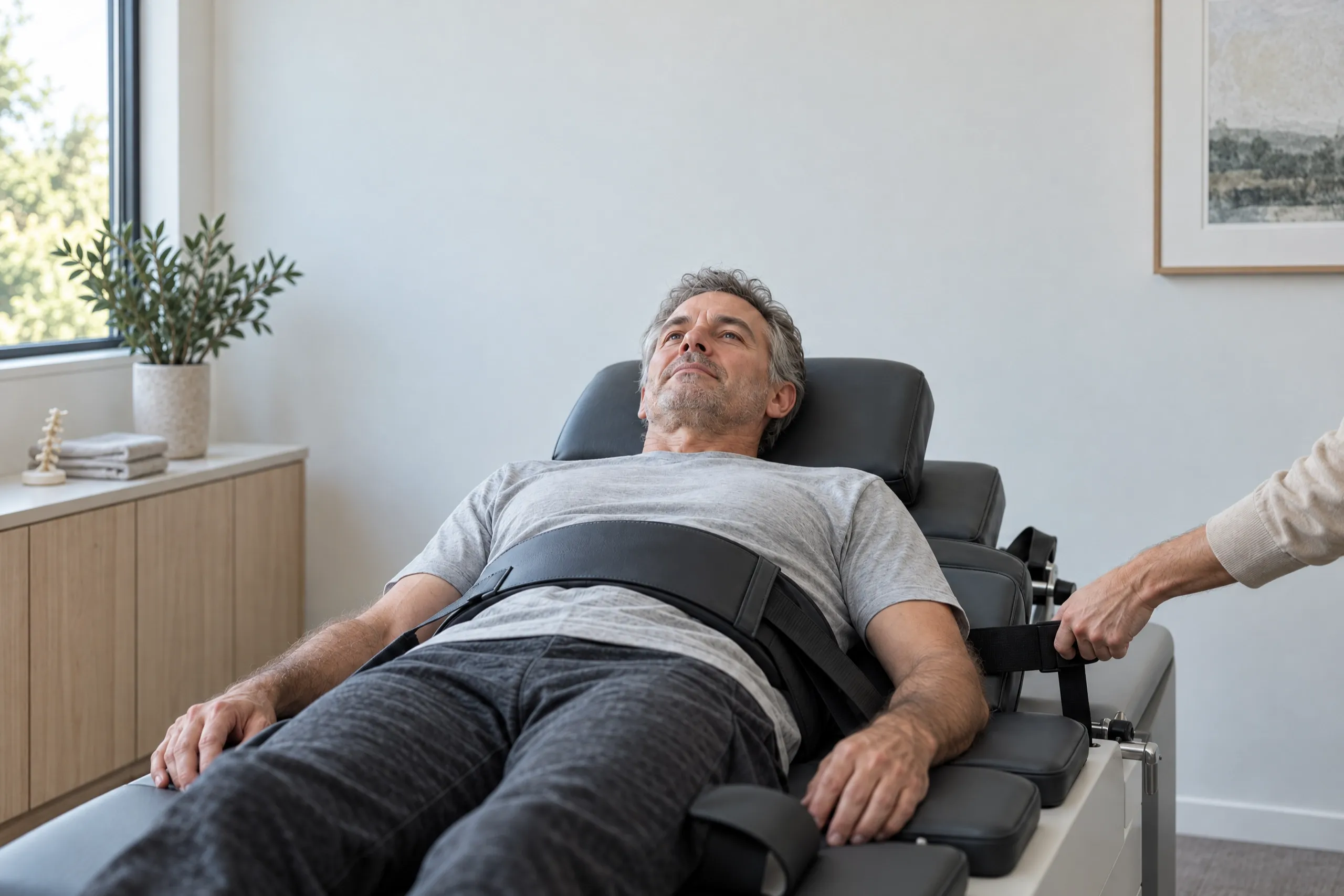
Computer-controlled traction that eases pressure on compressed discs and the nerves around them.
- No Surgery or Drugs
- Zero Downtime
- Targets the Disc
Explore More Related Treatments
Chiropractic Adjustments
Precise Gonstead adjustments for structural and postural correction, without drugs or surgery.
- Same-Day Relief
- Segment-Specific
- No Downtime
Explore More Related Treatments
Laser Therapy for Pain with Emvital
Relief for muscle and joint pain
- Drug-Free Relief
- No Downtime
- Comfortable Warmth
Explore More Related Treatments
Electrotherapy
Gentle electrical stimulation that calms pain signals and eases muscle tension.
- No Medication
- Comfortable Session
- No Downtime



Your Questions
Frequently Asked Questions
Is degenerative disc disease actually a disease?
Can degenerative disc disease be reversed?
Do I need an MRI before starting treatment?
Is degenerative disc disease the same as a herniated disc?
How long before I notice a difference?
What can I do at home between visits?
Does this mean I will eventually need surgery?
Contact Us
Schedule Your Consultation
Scientific References
- Brinjikji et al., AJNR American Journal of Neuroradiology. (2015). This systematic literature review of imaging features of spinal degeneration in asymptomatic populations found disc degeneration on imaging in 37 percent of 20-year-olds and 96 percent of 80-year-olds with no back pain. PMID: 25430861.
- Adams et al., Spine. (2006). What is intervertebral disc degeneration, and what causes it: a review concluding that genetic inheritance, aging and loss of disc nutrition outweigh mechanical loading alone. PMID: 16915105.
- Hartvigsen et al., The Lancet. (2018). What low back pain is and why we need to pay attention: a global review reporting that most low back pain cannot be attributed to a single identifiable structural cause. PMID: 29573870.
- Qaseem et al., Annals of Internal Medicine. (2017). Noninvasive treatments for acute, subacute, and chronic low back pain: a clinical practice guideline from the American College of Physicians that recommends non-drug care first. PMID: 28192789.
- Chou et al., Annals of Internal Medicine. (2017). Nonpharmacologic therapies for low back pain: a systematic review for an American College of Physicians clinical practice guideline, reporting small to moderate improvements in pain and function. PMID: 28192793.
- Paige et al., JAMA. (2017). Association of spinal manipulative therapy with clinical benefit and harm for acute low back pain: a systematic review and meta-analysis reporting modest improvement in pain and function. PMID: 28399251.