

Posture Correction in Camarillo, CA
Stand Tall Without Thinking About It
- Common In:
- Adults 20 to 65
- Primary Causes:
- Desk Work, Phones, Weak Core
- Treatment Time:
- 15-30 minutes
- Results:
- Weeks to months


What Poor Posture Actually Is
Recognizing the Signs
Poor posture is a pattern, not a single bad habit. The body adapts to the positions it spends the most hours in, so the head drifts forward of the shoulders, the upper back rounds, and the pelvis tips out of neutral. The muscles that should hold you upright grow long and quiet while the chest and hip flexors grow short and busy.
When you catch your reflection in a window and see your shoulders rolled forward, or notice your chin leading the way in a photograph, you are seeing that adaptation. It builds quietly across years of desk work, driving and phone use rather than arriving after one event.
Patients in Camarillo usually arrive describing something other than posture: an ache between the shoulder blades by mid-afternoon, a low back that complains after 20 minutes of standing, or a neck that never fully relaxes. Correction starts by finding which joints have stopped moving and which muscles have stopped working, then pairing chiropractic adjustments in Camarillo, CA with the strength work that holds the change.
Why Poor Posture Happens
Understanding the Root Causes
01The Science
Your head weighs roughly 10 to 12 pounds when it is balanced over the shoulders. Move it forward a couple of inches and the effective load on the neck and upper back climbs sharply, because the head now sits at the end of a lever. Hold that for eight hours a day and the deep neck flexors fatigue, the upper trapezius takes over, and the joints of the cervical and upper thoracic spine spend the day compressed.
The same trade-off happens lower down. Sitting shortens the hip flexors and leaves the glutes underused, so the pelvis rolls forward into an anterior tilt and the lumbar curve deepens to compensate. Clinicians describe the two patterns as upper crossed and lower crossed: predictable pairs of tight muscles with weak opposites that reinforce each other. The MedlinePlus guide to good posture from the National Library of Medicine describes the same relationship between alignment and muscular effort.
What makes posture stubborn is that the joints adapt as well as the muscles. Segments that sit at end range stop gliding properly, so a motivated patient cannot hold a corrected position their spine no longer has the motion to reach. That is why correction typically pairs joint work with core strengthening with Emsculpt Neo rather than leaning on either one alone.
02Deeper Understanding
Postural Adaptation or a Structural Curve?
Why the Distinction Changes the Plan
Most of what people call bad posture is postural adaptation: soft tissue and joint change built by repeated positions. It is flexible, which means it responds to mobilization, strengthening and altered habits. A useful clue is that the pattern partly corrects when you are cued to stand tall, or when you lie flat.
Structural change behaves differently. Adolescent idiopathic scoliosis involves rotation and lateral curvature of the vertebrae themselves, and Scheuermann kyphosis involves wedge-shaped thoracic vertebrae that set during growth. Neither straightens on cue and neither is corrected by exercise alone. Those cases call for imaging and, depending on severity and skeletal maturity, a referral pathway that may include bracing or surgical consultation.
Sorting one from the other is part of the first visit. Dr. Edmond Dooman, DC checks whether the curve reduces with a change of position, whether a rib prominence appears on forward bending, and whether motion is restricted at specific segments. If the findings point to a structural curve, you are told that plainly rather than enrolled in a correction plan that cannot deliver.
What Drives Poor Posture?
Posture is built by what you repeat, and most patients carry three or four of these drivers at once. The National Institute of Arthritis and Musculoskeletal and Skin Diseases lists prolonged sitting and deconditioning among the mechanical contributors to ongoing back pain.
- 01Desk and Screen HeightA monitor set below eye level pulls the head forward for hours, and the upper back rounds to follow it.
- 02Phone and Tablet UseLooking down at a handheld screen holds the neck in deep flexion, the posture pattern often labelled text neck.
- 03Weak Deep CoreWhen the deep abdominal and spinal stabilizers stop working, the pelvis loses its neutral anchor and the low back takes the load.
- 04Tight Hip FlexorsHours of sitting shorten the front of the hip, which tilts the pelvis forward and exaggerates the lumbar curve.
- 05Long CommutesCar seats push most drivers into a slumped, rounded position that the spine then treats as its default.
- 06Old Injuries and GuardingAfter a strain or a collision, muscles splint the sore area, and that protective pattern often outlives the injury itself.

Why Choose Camarillo Spine & Nerve Institute for Posture Correction Care in Camarillo, CA
- Gonstead Analysis First
- Specific segmental findings are identified before any adjustment is made, rather than a routine block of visits.
- 32 Years in Camarillo
- Dr. Dooman has worked with Ventura County spines from this practice since February 1994.
- Strength With Adjustment
- Joint work is paired with core strengthening, because alignment that nothing holds tends to drift back.
- Honest About Timelines
- Posture change takes weeks of consistent care and home work, and you hear that at the first visit.
Treatment Options Comparison
Compare the non-surgical options we use for posture correction so you can see how they differ in focus and timeline.
| Treatment | Best For | Session Time | Results Timeline | Maintenance |
|---|---|---|---|---|
| Chiropractic Adjustments | Restricted spinal segments | 15-20 min | Weeks | Periodic visits |
| Core Strengthening with Emsculpt Neo | Weak deep core support | 30 min | 4-8 weeks | Periodic series |
| Spinal Decompression Therapy | Disc-related low back load | 20-30 min | 2-6 weeks | Planned series |
| Laser Therapy for Pain with Emvital | Sore, overworked muscles | 10-20 min | 1-4 weeks | As needed |
You May Be Dealing With Poor Posture If...
These are the signs patients describe long before they use the word posture. If several sound familiar, an assessment is worth the visit, and patient education from the National Institute of Neurological Disorders and Stroke places body mechanics among the everyday factors linked to back pain.
Chin Leads in Photos
In side-on photographs your head sits ahead of your shoulders instead of stacked over them.
Afternoon Upper Back Ache
A burning ache builds between the shoulder blades by mid-afternoon and eases only once you stop working.
Rounded Shoulder Line
Your shoulders roll forward at rest, and shirts or jackets sit differently than they used to across the chest.
Standing Tightens the Low Back
Twenty minutes of standing in a line or at the counter leaves your low back tight and eager to sit down.
Correction Will Not Hold
You can straighten up when you think about it, but the position collapses within a minute or two of returning to work.
Headaches From the Neck
Headaches start at the base of the skull late in the day and track upward, often on the heaviest screen days.
Explore More Related Treatments
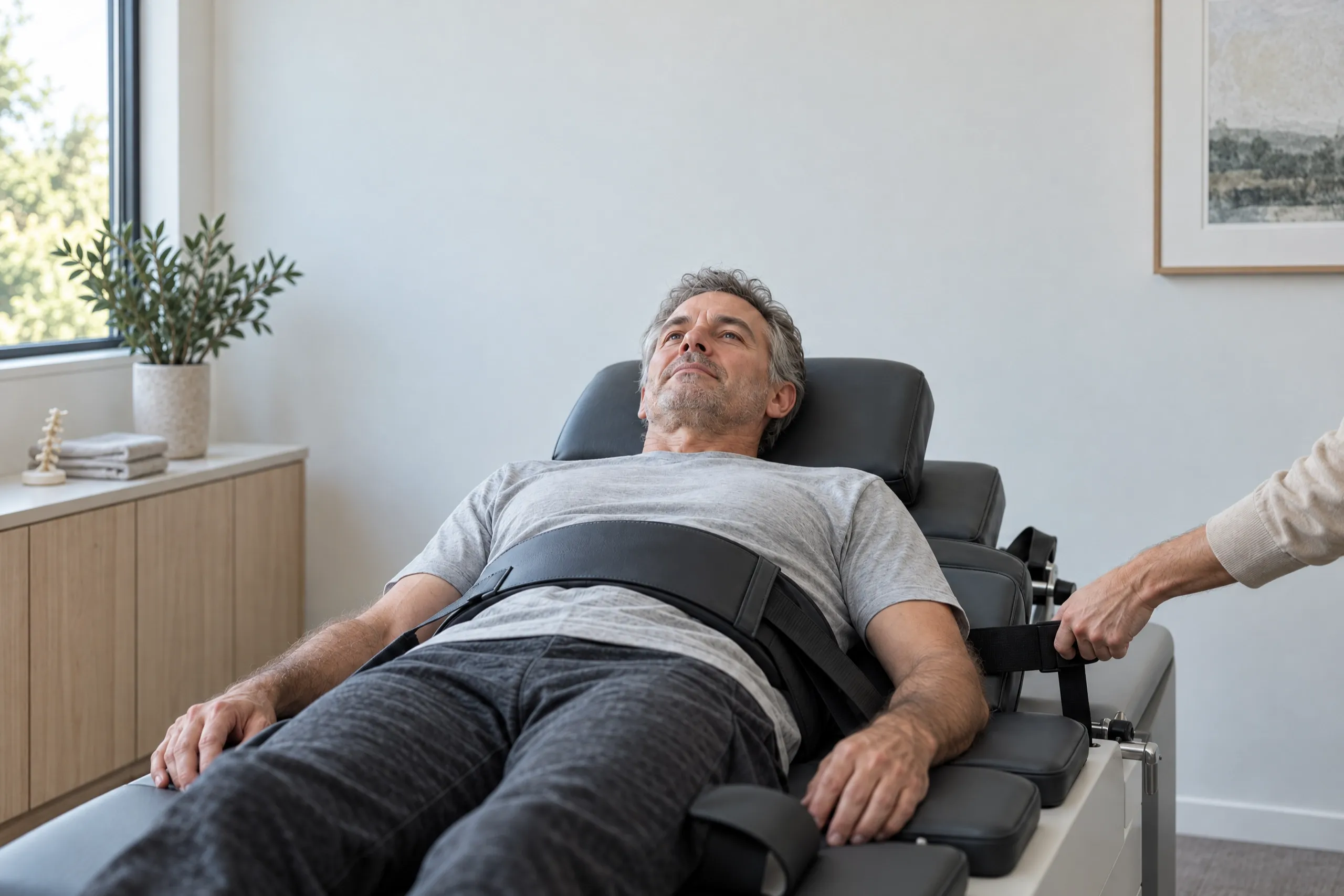
Spinal Decompression Therapy
Computer-controlled traction that eases pressure on compressed discs and the nerves around them.
- No Surgery or Drugs
- Zero Downtime
- Targets the Disc
Explore More Related Treatments
Chiropractic Adjustments
Precise Gonstead adjustments for structural and postural correction, without drugs or surgery.
- Same-Day Relief
- Segment-Specific
- No Downtime
Explore More Related Treatments
Core Strengthening with Emsculpt Neo
Non-surgical muscle stimulation that rebuilds the deep core supporting your spine and posture.
- Deep Core Activation
- No Downtime
- No Effort Required
Explore More Related Treatments
Pelvic Floor Therapy with Emsella
Thousands of pelvic floor contractions per session, sitting fully clothed on a chair.
- Stay Fully Clothed
- No Downtime
- Thousands of Kegels



Your Questions
Frequently Asked Questions
Can posture actually be corrected in adults?
How long does posture correction take?
Why does my posture collapse again after an adjustment?
Is forward head posture the same as text neck?
Can poor posture cause pain somewhere else?
Do posture braces work?
What does the first posture visit involve?
Contact Us
Schedule Your Consultation
Scientific References
- Mahmoud NF et al., Curr Rev Musculoskelet Med. (2019). Systematic review and meta-analysis linking forward head posture with neck pain in adults. PMID: 31773477.
- Sheikhhoseini R et al., J Manipulative Physiol Ther. (2018). Meta-analysis reporting that therapeutic exercise improves forward head posture measurements. PMID: 30107937.
- Chang MC et al., Healthcare (Basel). (2023). Narrative systematic review of treatment approaches for upper crossed syndrome. PMID: 37628525.
- Seidi F et al., Sci Rep. (2020). Corrective exercise program improved alignment, muscle activation and movement pattern in men with upper crossed syndrome. PMID: 33244045.
- Correia IMT et al., Spine (Phila Pa 1976). (2021). Cross-sectional study of the association between text neck and neck pain in adults. PMID: 33290371.
- Coulombe BJ et al., J Athl Train. (2017). Review comparing core stability exercise with general exercise for chronic low back pain. PMID: 27849389.