

Spinal Stenosis Treatment in Camarillo, CA
Walk farther, stand longer, and lean on the cart less.
- Common In:
- Adults 50 and older
- Primary Causes:
- Arthritis, disc settling, ligament thickening
- Treatment Time:
- 20-45 minutes per visit
- Results:
- Typically 4-12 weeks


What Is Spinal Stenosis?
Recognizing the Signs
Spinal stenosis is a narrowing of the spinal canal or of the small side openings called foramina, the tunnels the spinal cord and nerve roots travel through. As that space closes down, the nerves lose the room they need and become irritated, inflamed and compressed.
When you stand at the kitchen counter or walk to the end of the block and your legs start to ache, burn or feel heavy, you are describing neurogenic claudication, the hallmark symptom of lumbar spinal stenosis. Sit down or lean forward over a cart and the same legs usually settle within a few minutes.
Patients across Camarillo and Ventura County tell us the same story: the walks got shorter, the store with the carts became the preferred store, and outings now get planned around where there is somewhere to sit. Spinal stenosis narrows your day before you ever see it on an image.
Why Spinal Stenosis Happens
Understanding the Root Causes
01The Science
A healthy spinal canal is built with room to spare. Decades of degenerative change take that margin away: discs lose height and bulge backward, facet joints enlarge with arthritis, and the ligamentum flavum, the elastic band lining the back of the canal, thickens and buckles inward. The National Institute of Arthritis and Musculoskeletal and Skin Diseases identifies this age-related wear as the most common source of the narrowing.
Standing and walking extend the spine, which shortens the canal, folds the ligament inward and reduces blood flow to the nerve roots. That is the mechanism behind the pattern patients describe so consistently: symptoms build with distance, then fade within minutes of sitting or bending forward.
Conservative care cannot widen bone, and we say so plainly. What it can do is take load and irritation off the narrowed segment. Non-surgical spinal decompression gently separates the vertebrae and lowers pressure inside the disc, which many patients feel as more walking tolerance before the legs start to complain.
02Deeper Understanding
Central and Foraminal Stenosis
How the Location of Narrowing Shapes Symptoms
Central stenosis squeezes the main canal down the middle of the spine, so symptoms usually show up in both legs at once as heaviness, fatigue and cramping that build with walking. Foraminal or lateral recess stenosis pinches a single nerve root as it exits the spine, so the pain follows one nerve down one leg and can look very much like sciatica.
The level matters just as much. Lumbar stenosis affects the low back, buttocks and legs. Cervical stenosis narrows the canal in the neck, and because the spinal cord itself passes through that region it can produce clumsy hands, difficulty with buttons and zippers, an unsteady walk and changes in balance. Those cord-level signs call for prompt imaging and medical evaluation rather than watchful waiting.
Most people have some mix of both, often layered on top of degenerative disc disease. Sorting out which pattern dominates changes the plan: one irritated root often responds to targeted care such as electrotherapy in Camarillo, CA alongside decompression, while multilevel central narrowing needs a broader and more patient approach.
What Accelerates Spinal Stenosis?
Several changes stack up over decades to close down the canal, and stiff segments above and below the narrowed level add to the load. Chiropractic adjustments in Camarillo, CA address that segmental stiffness so the narrowed level carries less of the work.
- 01Age-Related ArthritisFacet joints enlarge as spinal arthritis progresses, and the extra bone crowds both the canal and the nerve exits.
- 02Disc Height LossAs discs dry out and flatten, they bulge backward and the vertebrae settle closer together, shrinking the side openings.
- 03Ligament ThickeningThe ligamentum flavum stiffens and buckles inward with age, taking up space along the back wall that the nerves need.
- 04A Naturally Narrow CanalSome people are born with less room to begin with, so ordinary wear produces symptoms a decade or two earlier than expected.
- 05Vertebral SlippageWhen one vertebra shifts forward on the one below it, the canal is offset and pinched at that level, most often at L4 and L5.
- 06Extension PosturesWork and hobbies that keep you standing, arching or reaching overhead hold the canal in its narrowest position for hours.

Why Choose Camarillo Spine & Nerve Institute for Spinal Stenosis Care
Dr. Edmond Dooman, DC has cared for Ventura County spines since the practice opened in February 1994 and uses the Gonstead Method to work at the specific segment that is actually involved. Meet Dr. Edmond Dooman, DC.
- Over 32 Years of Experience
- Dr. Dooman has treated Camarillo spine patients continuously since the practice was founded in February 1994.
- Gonstead Method Precision
- Adjustments are directed at the segment identified on examination rather than applied broadly across the region.
- Honest About the Limits
- We tell you plainly when stenosis has moved past what conservative care manages and needs surgical evaluation.
- Non-Surgical Technology
- Decompression, laser and electrotherapy units let us unload the narrowed segment without drugs or injections.
Treatment Options Comparison
Compare the non-surgical options we use for spinal stenosis so you know what each one is meant to do.
| Treatment | Best For | Session Time | Results Timeline | Maintenance |
|---|---|---|---|---|
| Spinal Decompression Therapy | Unloading a narrowed segment | 20-30 minutes | 4-8 weeks | Periodic tune-ups |
| Chiropractic Adjustments | Stiff segments above and below | 15-20 minutes | 2-6 weeks | As symptoms dictate |
| Pinched Nerve Treatment | One irritated nerve root | 20-40 minutes | 3-8 weeks | Symptom driven |
| Electrotherapy | Muscle guarding and pain signals | 10-20 minutes | Same visit to 4 weeks | Added to visits |
You May Be Experiencing Spinal Stenosis If...
These patterns point toward a narrowed canal rather than ordinary back pain, and MedlinePlus describes the same picture. One exception matters: loss of bladder or bowel control, numbness through the groin or saddle area, or leg weakness that is getting worse quickly is a medical emergency and belongs in an emergency department, not in a plan for nerve compression care in Camarillo, CA.
Leg Pain When Walking
Your legs ache, burn or cramp after a predictable distance, and that distance keeps getting shorter month by month.
Relief the Moment You Sit
Symptoms fade within a few minutes of sitting down, then return soon after you stand back up and start moving.
The Shopping Cart Sign
You can walk far leaning forward on a cart, yet only a fraction of that distance walking upright with your arms free.
Heavy, Tired Legs
Your legs feel weighted or rubbery rather than sharply painful, and they give out long before you run short of breath.
Numbness and Tingling
Pins and needles or numbness spread into the buttocks, thighs or feet, frequently on both sides at the same time.
Easier Uphill Than Down
Climbing or pushing a cart feels easier than walking downhill, because leaning forward temporarily opens the canal.
Explore More Related Treatments
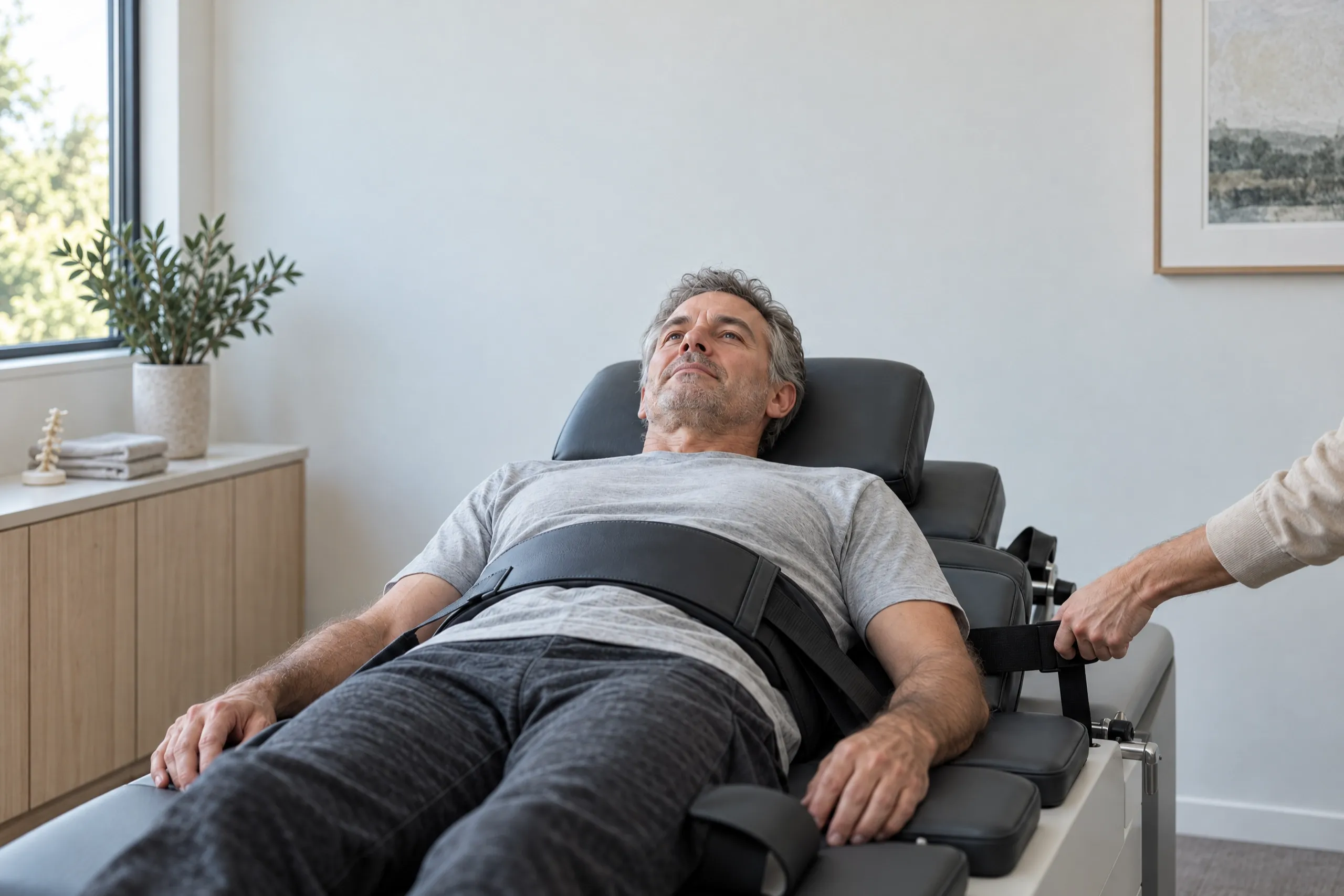
Spinal Decompression Therapy
Computer-controlled traction that eases pressure on compressed discs and the nerves around them.
- No Surgery or Drugs
- Zero Downtime
- Targets the Disc
Explore More Related Treatments
Chiropractic Adjustments
Precise Gonstead adjustments for structural and postural correction, without drugs or surgery.
- Same-Day Relief
- Segment-Specific
- No Downtime
Explore More Related Treatments
Peripheral Neuropathy Treatment
Drug-free, non-surgical care for the numbness, burning, and tingling of nerve damage.
- Drug-Free Approach
- No Downtime
- Non-Invasive Care
Explore More Related Treatments
Pinched Nerve Treatment
Non-surgical care that relieves pressure on compressed, irritated nerves.
- Drug-Free Relief
- No Downtime
- Targeted Decompression



Your Questions
Frequently Asked Questions
Can spinal stenosis be reversed without surgery?
Why does sitting down relieve my leg pain so quickly?
How do I know whether it is stenosis or sciatica?
Is spinal stenosis simply a normal part of aging?
When does spinal stenosis need surgical evaluation instead?
What is the difference between lumbar and cervical stenosis?
Can chiropractic care make spinal stenosis worse?
What can I do at home between visits?
Contact Us
Schedule Your Consultation
Scientific References
- Katz JN et al., JAMA. (2022). Review of lumbar spinal stenosis describes neurogenic claudication relieved by sitting or forward flexion as the defining clinical feature. PMID: 35503342.
- Katz JN et al., N Engl J Med. (2008). Clinical practice review of lumbar spinal stenosis outlines the degenerative mechanism and the role of nonoperative care. PMID: 18287604.
- Schneider MJ et al., JAMA Netw Open. (2019). Comparative clinical effectiveness of nonsurgical treatment methods in patients with lumbar spinal stenosis, a randomized clinical trial, found manual therapy with individualized exercise improved walking capacity. PMID: 30646197.
- Delitto A et al., Ann Intern Med. (2015). Randomized trial of surgery versus nonsurgical treatment for lumbar spinal stenosis reported similar physical function outcomes at two years. PMID: 25844995.
- Vanti C et al., Phys Ther. (2021). Systematic review and meta-analysis of mechanical traction for lumbar radiculopathy. PMID: 33382419.
- Qaseem A et al., Ann Intern Med. (2017). American College of Physicians guideline recommends noninvasive, nondrug treatment as first-line care for low back pain. PMID: 28192789.
- National Institute of Arthritis and Musculoskeletal and Skin Diseases. (2023). Overview of lumbar spinal stenosis symptoms, causes and treatment approaches.