

Herniated Disc Treatment in Camarillo, CA
Take the pressure off the nerve so the pain, numbness and weakness have room to settle.
- Common In:
- Adults 30 to 60
- Primary Causes:
- Disc wear, strain, injury
- Treatment Time:
- 20 to 45 minutes
- Results:
- Weeks to a few months


What Is a Herniated or Bulging Disc?
Recognizing the Signs
Each spinal disc is a flexible cushion between two vertebrae: a tough outer ring called the annulus wrapped around a soft gel center called the nucleus. A bulging disc is one where the outer ring has flattened and pushed outward all the way around, like a tire losing pressure. A herniated disc is one where part of that inner gel has pressed through a weak spot in the ring. Both can crowd a nerve root, and both can happen in the neck or the low back.
When a disc presses on a nerve, the pain often shows up somewhere other than the spine. A lumbar disc at L4-L5 or L5-S1 usually sends pain, numbness or tingling down the buttock and leg. A cervical disc at C5-C6 or C6-C7 sends it into the shoulder, arm or hand. That is why people describe leg pain or a dead arm long before they suspect a disc.
Most people arrive here after months of guarding their movements: sitting on one hip, avoiding the car, dreading a sneeze. It is a frustrating condition because the pain moves and the cause is hidden. Understanding what is actually happening in the spine is the first step toward treating it without surgery.
Why Herniated and Bulging Discs Happen
Understanding the Root Causes
01The Science
Spinal discs are roughly 80 percent water at birth and dry out steadily with age. As water content falls, the disc loses height and the annulus becomes stiffer and more brittle. A ring that once absorbed load now develops small radial tears, and the pressure inside the disc concentrates on those weak points instead of spreading evenly.
Bending forward loads the front of the disc and pushes the nucleus backward, which is exactly where the nerve roots sit. Repeat that thousands of times, add a heavy lift or an awkward twist, and gel can migrate through a tear. The National Institute of Neurological Disorders and Stroke describes disc rupture and degeneration as among the most common mechanical causes of back pain in adults.
Pain is not purely mechanical. Displaced nucleus material is chemically irritating to nerve tissue, so a small herniation that barely touches a nerve can hurt badly while a large one sits quietly. That chemical piece is part of why taking pressure off the disc with non-surgical spinal decompression can change symptoms before anything looks different on an image.
02Deeper Understanding
What Your X-Ray Shows, and What It Cannot
Understanding Your In-Office X-Ray Results
Every patient is X-rayed in our office at the first visit. Spinal X-rays show alignment, disc height, bone spurs and the spacing between vertebrae, so a narrowed disc space at one level tells Dr. Dooman where a disc has lost height and which nerve level to test. X-rays also rule out fracture and other bone problems before any care begins. Disc material itself does not show on an X-ray. If you already have an MRI, bring the report and Dr. Dooman will review it alongside your films, but an MRI is not required to start care.
Here is the part that surprises most patients: disc findings on any kind of imaging are extremely common in people with no pain at all. Imaging reviews of asymptomatic adults find disc bulges in a large share of people in their forties and fifties, and the numbers climb with every decade. A report that says bulging disc is not by itself a diagnosis. What matters is whether the finding matches your symptoms, your reflexes and the specific nerve level being tested. MedlinePlus makes the same point for patients.
There is good news in the other direction too. Larger herniations, the ones that sound worst on paper, are the most likely to shrink on their own as the body reabsorbs the displaced material over weeks to months. Care during that window is aimed at calming the irritated nerve and keeping you moving, which is where pinched nerve treatment in Camarillo, CA and graded activity fit in. Leg pain from a lumbar disc is often labelled sciatica, and the two pages overlap heavily.
What Makes a Disc More Likely to Herniate?
Discs rarely fail from one bad moment. Several factors usually stack up over years, and the lift you remember is often just the last straw. Restoring normal joint motion with chiropractic adjustments in Camarillo, CA addresses several of them at once.
- 01Age-Related DryingDisc water content drops steadily after the twenties, so the outer ring stiffens and tears more easily under load.
- 02Repeated Bending and LiftingForward bending drives the nucleus backward toward the nerve roots, and thousands of repetitions wear a path through the ring.
- 03Long Hours SeatedSitting raises pressure inside a lumbar disc more than standing does, especially with a rounded low back and a long commute.
- 04Sudden Strain or TraumaA fall, a collision or an awkward twist under load can tear a ring that was already thinning quietly for years.
- 05Weak Core and Hip SupportWhen deep trunk muscles do not share the load, the discs and small spinal joints absorb forces they were never meant to carry alone.
- 06Smoking and Poor CirculationDiscs have almost no blood supply of their own, so anything that narrows small vessels slows the nutrient exchange they depend on.

Why Choose Camarillo Spine & Nerve Institute for Herniated Disc Care in Camarillo, CA
- Exam With X-Ray Before Any Plan
- Reflexes, strength and sensation are mapped to a nerve level, and X-rays are taken in office, before a single session is booked
- Gonstead Method
- Specific, hands-on adjusting rather than generalized manipulation of the whole spine
- Non-Surgical First
- Decompression, laser and adjustments are used well before surgery enters the conversation
- Honest About Limits
- We say so and refer out when a disc needs advanced imaging, medical care or a surgical opinion
Treatment Options Comparison
Compare the non-surgical options we use for herniated and bulging discs in Camarillo, CA.
| Treatment | Best For | Session Time | Results Timeline | Maintenance |
|---|---|---|---|---|
| Spinal Decompression Therapy | Disc pressure and leg pain | 20 to 30 minutes | 2 to 6 weeks | Occasional tune-ups |
| Chiropractic Adjustments | Restricted joints and guarding | 10 to 20 minutes | 1 to 4 weeks | Periodic |
| Pinched Nerve Treatment | Numbness, tingling, weakness | 20 to 40 minutes | 2 to 8 weeks | As needed |
| Laser Therapy for Pain with Emvital | Muscle guarding around the irritated nerve | 10 to 20 minutes | 2 to 6 weeks | Periodic |
Signs You May Have a Herniated or Bulging Disc
Disc symptoms follow the nerve, not the spine, so the clue is where the pain travels and what makes it worse. If several of these sound familiar, an exam that maps them to a nerve level is worth having, and pinched nerve treatment is often where care begins. Numbness in the groin, loss of bladder or bowel control or weakness in both legs needs an emergency department the same day.
Pain Down One Leg
A sharp or burning line of pain running from the buttock into the thigh, calf or foot, usually worse than the back pain itself.
Numbness or Tingling
Pins and needles or a patch of numb skin that follows a strip down the leg or out the arm rather than spreading everywhere.
Worse Sitting, Better Walking
Sitting, driving or leaning forward spikes the pain, while standing up and moving gives you a few minutes of relief.
Neck Pain Into the Arm
Cervical disc pressure often shows up as shoulder blade ache with tingling into the thumb, middle fingers or pinky side of the hand.
Grip or Foot Weakness
Dropping things, catching a toe on the carpet or struggling to rise on one heel points to a specific nerve losing signal strength.
Pain With Cough or Sneeze
A jolt of leg or arm pain when you cough, sneeze or strain is a classic sign that pressure inside the disc is reaching a nerve.
Explore More Related Treatments
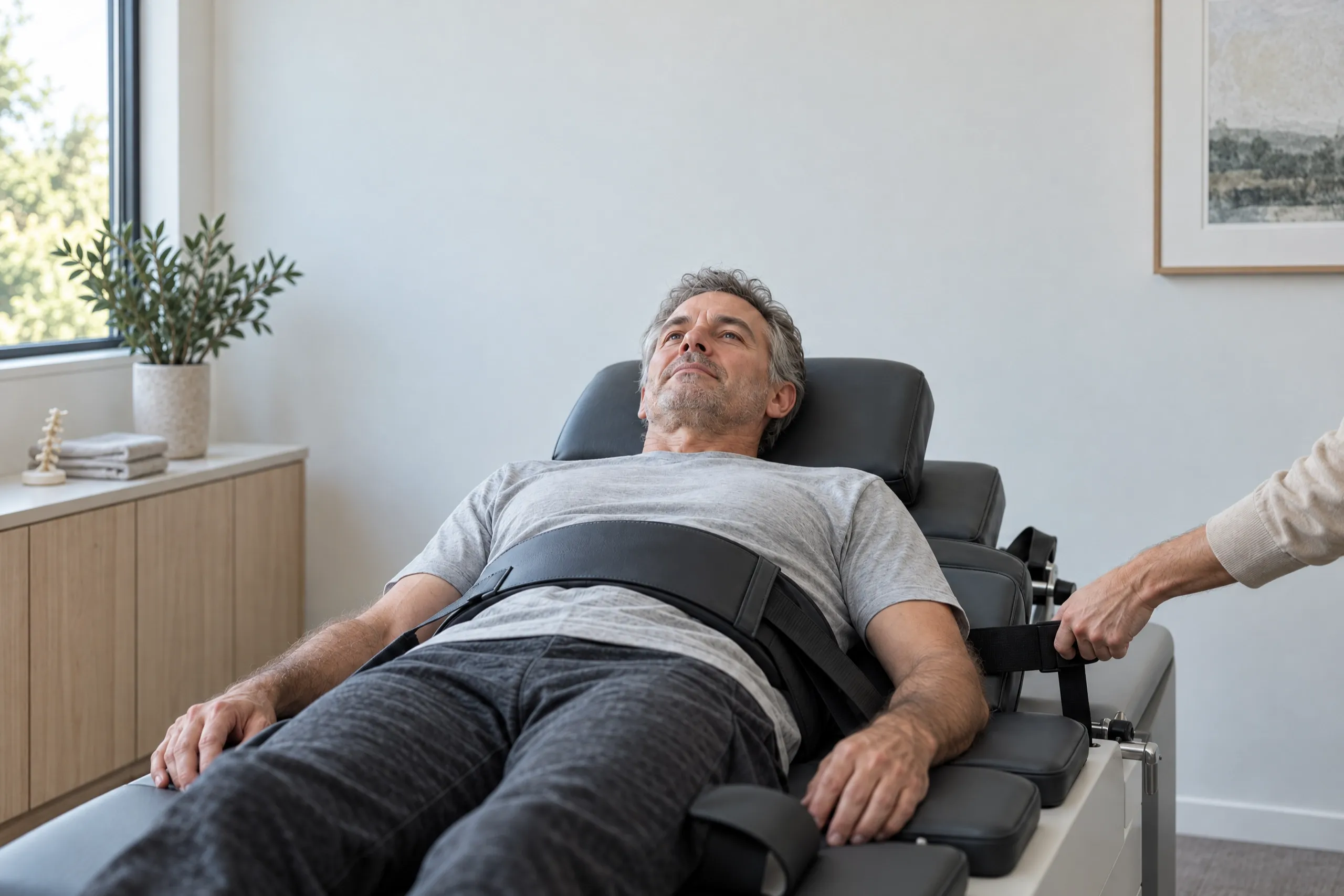
Spinal Decompression Therapy
Computer-controlled traction that eases pressure on compressed discs and the nerves around them.
- No Surgery or Drugs
- Zero Downtime
- Targets the Disc
Explore More Related Treatments
Chiropractic Adjustments
Precise Gonstead adjustments for structural and postural correction, without drugs or surgery.
- Same-Day Relief
- Segment-Specific
- No Downtime
Explore More Related Treatments
Peripheral Neuropathy Treatment
Drug-free, non-surgical care for the numbness, burning, and tingling of nerve damage.
- Drug-Free Approach
- No Downtime
- Non-Invasive Care
Explore More Related Treatments
Pinched Nerve Treatment
Non-surgical care that relieves pressure on compressed, irritated nerves.
- Drug-Free Relief
- No Downtime
- Targeted Decompression



Your Questions
Frequently Asked Questions
What is the difference between a bulging disc and a herniated disc?
Can a herniated disc heal without surgery?
How long does non-surgical bulging disc treatment take to work?
Can a disc in my neck cause arm pain and hand tingling?
When is a herniated disc a medical emergency?
My MRI shows a bulging disc, so is that what is causing my pain?
What does herniated disc treatment cost in Camarillo?
Contact Us
Schedule Your Consultation
References
- Fardon et al., The Spine Journal. (2014). Lumbar disc nomenclature version 2.0 defines disc bulge, protrusion, extrusion and sequestration as distinct imaging findings. PMID: 24768732.
- Brinjikji et al., American Journal of Neuroradiology. (2015). Systematic literature review of imaging features of spinal degeneration in asymptomatic populations found disc bulges and protrusions to be common in people without symptoms. PMID: 25430861.
- Chiu et al., Clinical Rehabilitation. (2015). Systematic review of the probability of spontaneous regression of lumbar herniated disc reported high rates of resorption, particularly for extruded and sequestrated discs. PMID: 25009200.
- Hahne et al., Spine. (2010). Systematic review of conservative management of lumbar disc herniation with associated radiculopathy found improvement in most patients managed without surgery. PMID: 20421859.
- Weinstein et al., JAMA. (2006). Surgical versus nonoperative treatment for lumbar disk herniation in the Spine Patient Outcomes Research Trial showed substantial improvement in both the surgical and nonoperative groups over two years. PMID: 17119141.
- Qaseem et al., Annals of Internal Medicine. (2017). Noninvasive treatments for acute, subacute and chronic low back pain clinical practice guideline recommends nonpharmacologic care as the first line of treatment. PMID: 28192789.
- National Institute of Neurological Disorders and Stroke. (2025). Patient guidance on mechanical causes of back pain including disc rupture and degeneration.